Description
GE CK85BA300 Three-Pole AC Contactor
Product Overview
The GE CK85BA300 is a heavy-duty three-pole AC contactor from GE’s CK85 contactor family, intended for switching substantial three-phase electrical loads. Available technical records identify the CK85BA300 as an AC-3 contactor for motor-control applications, with a 315 A thermal current rating and a 380–400 VAC motor rating of approximately 110 kW. A procurement specification for this exact model identifies 50/60 Hz operation, 205 A at 380/400 VAC under the stated AC-3 application, 110 kW motor capacity, and 1000 V insulation voltage.
The GE CK85BA300 is therefore better treated as a motor-switching device than as a general-purpose relay. Its three main contacts connect and disconnect the three phases of a motor feeder, while the auxiliary contacts can be used for control-circuit interlocking, contactor-status feedback, or holding logic. The exact coil assembly is a separate procurement concern. Records associated with this model identify a C-04255N / C 655-00 coil for 220–230 VAC at 50 Hz / 277 VAC at 60 Hz, but the coil should be verified against the actual contactor nameplate because coil voltage is not safely inferred from the base CK85BA300 designation alone.
For the GE CK85BA300, the important replacement issue is not simply finding another CK85 housing. Motor current, utilization category, operating voltage, coil voltage, auxiliary-contact arrangement, and mechanical configuration all need to match. Some available listings describe the product with generic 220 VAC language, while the exact contactor’s load ratings vary substantially with operating voltage. For procurement, use the complete nameplate and application voltage rather than applying the 315 A figure directly as an AC-3 motor current rating.
Technical Specifications
| Parameter | Specification |
|---|---|
| Product Model | |
| Manufacturer | General Electric (GE) |
| Product Type | Three-pole AC contactor |
| Series | CK85 |
| Utilization Category | AC-3 |
| Rated Frequency | 50/60 Hz |
| Thermal Current | 315 A |
| Rated Operational Voltage | Application-dependent; 380–400 VAC rating documented |
| Motor Rating at 380–400 VAC | Approximately 110 kW / 150 hp |
| AC-3 Current at 380–400 VAC | 205 A reported in procurement documentation |
| Insulation Voltage (Ui) | 1000 V reported |
| Main Contacts | 3-pole |
| Auxiliary Contacts | 1 NO + 1 NC reported |
| Coil | Verify exact installed coil code |
| Documented Coil Option | C-04255N / C 655-00, 220–230 VAC 50 Hz / 277 VAC 60 Hz |
| Mounting | Panel / contactor assembly |
| Communications | None |
| Primary Application | Three-phase motor control |
The 315 A figure should not be confused with the AC-3 motor current at every voltage. GE contactor ratings are application- and voltage-dependent. One technical listing gives 315 A thermal current while separately giving different motor horsepower/kW values at 220–230, 380–400, 415–440, 500, and 660–690 VAC.
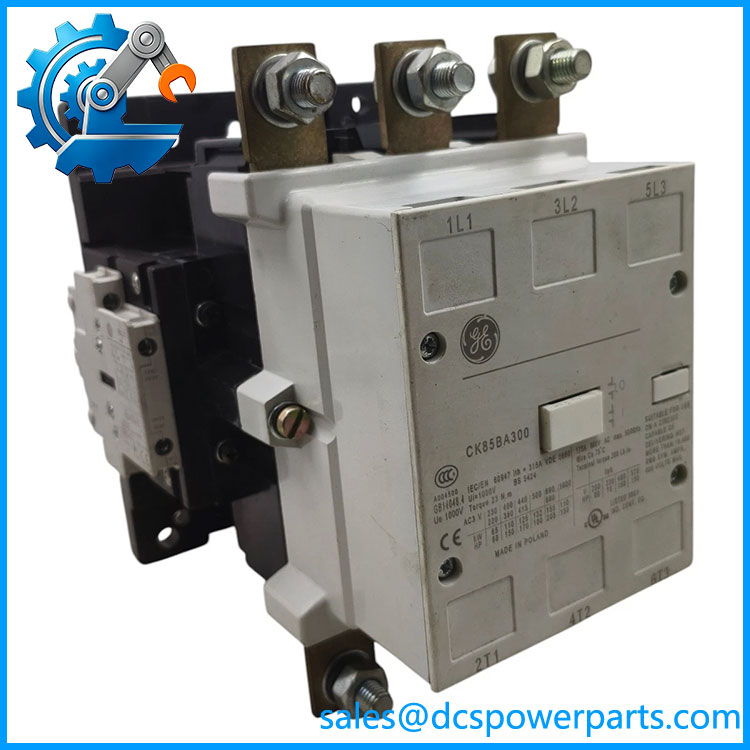
CK85BA300
Main Features and Engineering Considerations
The is designed around conventional electromechanical motor switching. Its three main poles simultaneously switch the three phases, making the device suitable for motor feeders where the contactor is controlled by a separate starter, relay, PLC output, or motor-control circuit. The AC-3 designation is important because motor starting imposes substantially different electrical stress from a simple resistive load.
The contactor’s rated current must be selected against the actual motor and application, not merely against the thermal-current number printed in a catalog. The 315 A value represents a thermal-current capability reported for the device, while the documented AC-3 rating at 380–400 VAC is lower. The actual motor rating should therefore be checked against voltage, motor duty, starting frequency, enclosure conditions, and applicable coordination requirements.
The coil is another common field-replacement trap. The base part number does not provide enough information to safely assume the control-coil voltage. A procurement record identifies C-04255N / C 655-00 as a 220–230 VAC, 50 Hz / 277 VAC, 60 Hz coil used with . Other coil configurations may exist, so the installed coil marking should be recorded before ordering.
Auxiliary contacts should also be checked before substitution. A reported 1NO + 1NC configuration may be essential to the existing starter logic, particularly when one contact is used for seal-in and another for PLC or relay feedback. A mechanically compatible contactor with a different auxiliary arrangement can require control-panel rewiring.
Procurement and Replacement Checks
- Confirm the complete nameplate.
- Verify motor voltage and full-load current.
- Confirm AC-3 duty rather than relying on thermal-current rating.
- Check the installed coil part number and control voltage.
- Verify 50/60 Hz coil requirements.
- Confirm auxiliary-contact arrangement.
- Inspect main-terminal condition and contact wear.
- Check mechanical mounting and busbar/cable arrangement.
- Confirm starter overload and short-circuit coordination.
- Test contactor pickup, dropout, phase switching, and auxiliary feedback after replacement.
Application Scenarios
- Large three-phase motor starters
- Industrial motor feeders
- Pumps and compressors
- Fans and blowers
- Conveyor drives
- Process machinery
- Industrial HVAC equipment
- Motor-control panels
- Heavy-duty AC-3 switching applications
Engineer’s Guide: Field Pitfalls
Do not use 315 A as the motor rating.
The 315 A value is reported as thermal current. The documented AC-3 current at 380–400 VAC is 205 A, so the two figures have different meanings.
Check the coil separately.
A replacement contactor with the wrong coil voltage can fail to operate or damage the control circuit. Verify the actual coil marking.
Do not ignore auxiliary contacts.
The auxiliary contacts may be part of the motor starter’s electrical interlock or PLC feedback circuit.
Check contact condition.
Pitted or welded main contacts can indicate overload, short-circuit stress, excessive starting frequency, or inadequate coordination upstream.
Verify application voltage.
The has different motor power/current ratings depending on operating voltage. Do not copy the 380–400 VAC rating into a 500 V or 660–690 V application.
Inspect the complete starter.
A new contactor will not correct an incorrectly sized overload relay, damaged suppression device, poor termination, or upstream protection problem.
Frequently Asked Questions
What is GE ?
It is a three-pole GE CK85-series AC contactor intended primarily for three-phase motor switching.
What is its thermal current rating?
Available records identify 315 A as the thermal-current rating. This is not equivalent to the AC-3 motor current rating at every operating voltage.
What motor can control at 380–400 VAC?
A procurement specification identifies approximately 110 kW / 150 hp at 380–400 VAC, with an AC-3 current of 205 A in that application.
Does have auxiliary contacts?
Records for the assembly identify 1 normally open and 1 normally closed auxiliary contact. Verify the physical contact block before replacement.
What coil voltage does it use?
The base model alone should not be used to infer the coil voltage. One documented application uses the C-04255N / C 655-00 coil rated 220–230 VAC at 50 Hz and 277 VAC at 60 Hz. Verify the installed coil marking.
Does it communicate with a PLC?
No. The is an electromechanical contactor with no native Ethernet, Modbus, or other digital communications interface. PLC integration is normally performed through the contactor’s control coil and auxiliary contacts.
Procurement Note
For a replacement , the critical identification data are complete model number, coil code, main-contact configuration, auxiliary contacts, motor voltage, motor current, and AC-3 duty. The 315 A thermal rating should not be used as a blanket motor-rating figure. For an existing starter, photograph the nameplate and coil before purchasing; the coil and auxiliary configuration can materially affect interchangeability.