Description
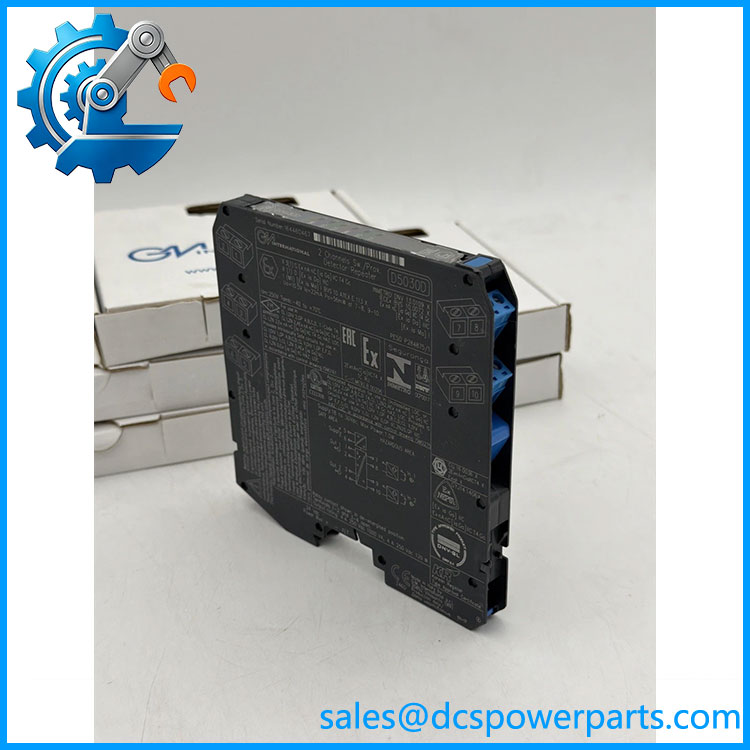
G.M. International D5030D SIL 3 Switch/Proximity Detector Repeater
Product Introduction
In a hazardous-area digital signal loop, a proximity detector or dry contact cannot simply be wired into a conventional PLC input without considering intrinsic-safety requirements and signal isolation. G.M. International D5030D is a two-channel D5000 Series repeater designed to accept switch or proximity-detector signals from hazardous areas and reproduce their states through relay contacts in the safe area. G.M. International specifies the device for safety-related applications up to SIL 3.
The D5030D provides two independent channels, three-port isolation, field open/short-circuit detection, and configurable relay behavior. Its second output can also be configured for signal duplication or first-channel fault indication, depending on the application. This makes the unit useful in safety instrumentation, process shutdown systems, hazardous-area monitoring, and marine/offshore installations where a simple digital input repeater is not sufficient.
Key Technical Specifications
| Parameter | Specification |
|---|---|
| Product Model | D5030D |
| Manufacturer | G.M. International S.p.A. |
| Product Series | D5000 |
| Product Type | SIL 3 switch/proximity detector repeater |
| Number of Channels | 2 |
| Safety Integrity | SIL 3 / SC 3 |
| Hazardous-Area Input | Zone 0 / Division 1 |
| Installation Area | Zone 2 / Division 2 or safe area |
| Input Devices | Voltage-free contact, proximity switch/detector |
| Input ON Threshold | ≥ 2.1 mA |
| Input OFF Threshold | ≤ 1.2 mA |
| Open-Circuit Fault | ≤ 0.2 mA |
| Short-Circuit Fault | ≥ 6.8 mA |
| Equivalent Input Source | 8 V / 1 kΩ typical |
| Supply | 24 VDC nominal |
| Supply Range | 18–30 VDC |
| Supply Protection | Reverse-polarity protected |
| Typical Consumption | 35 mA at 24 VDC |
| Output | Voltage-free SPST relay contact |
| Relay Contact Rating | 4 A at 250 VAC / 1000 VA resistive |
| DC Contact Rating | 4 A at 250 VDC / 120 W resistive |
| Minimum Switching Current | 1 mA |
| Typical Operate / Release Time | 8 / 4 ms |
| Maximum Frequency Response | 10 Hz |
| Isolation | Three-port galvanic isolation |
| Isolation Test Voltage | Up to 2.5 kV on specified ports |
| Operating Temperature | -40 to +70 °C |
| Storage Temperature | -45 to +80 °C |
| Mounting | 35 mm DIN rail |
| Width | 12.5 mm |
| Depth | 123 mm |
| Height | 120 mm |
| Approx. Weight | 140 g |
| Terminal Capacity | Up to 2.5 mm² / 13 AWG |
These values are documented in G.M. International’s D5000/D5200 technical catalog and product documentation.
Application Scenarios & Pain Points
Hazardous-Area Proximity Detection
The D5030D is designed to interface proximity detectors installed in hazardous locations with safe-area control equipment. The input circuit is intrinsically safe and supports the electrical characteristics required for the specified field devices.
D5030D
Safety Instrumented Systems
With its SIL 3 / SC 3 classification, the module is intended for safety-related applications where the digital state of a field switch or proximity detector must be transferred through an appropriate safety interface. The module’s certification does not, by itself, make the complete safety loop SIL 3; the complete SIF still requires appropriate system-level engineering.
Emergency Shutdown and Interlock Signals
The relay output provides a voltage-free contact for connection to downstream PLC, DCS, ESD, or relay logic. The output can reproduce the input state or, in the dual-channel configuration, be assigned to duplication or fault-reporting functions.
Offshore and Marine Applications
G.M. International documents the D5000 family for offshore and marine applications, and the D5030D is also identified in marine-oriented product documentation. Its compact 12.5 mm width allows two channels in a narrow DIN-rail footprint.
Related Products
- D5030S — single-channel version with SPDT relay output; it should not be treated as a two-channel equivalent.
- D5031D — dual-channel digital input repeater using open-collector outputs rather than the relay-output arrangement.
- D5032D — related dual-channel switch/proximity repeater family with different line-monitoring/output configuration.
- D5231E — 8-channel digital input repeater with open-collector outputs; different channel density and output architecture.
- JDFT049 — D5000 Series bus connector accessory.
- OPT5096 — D5000 Series bus mounting kit.
These are related -family components, not automatic replacements. Output architecture and safety configuration must be checked before substitution.
Engineer’s Guide — Field Pitfalls to Avoid
1. Do not confuse with an ordinary relay interface.
The field side is designed for intrinsically safe switch/proximity-detector circuits. Its hazardous-area entity parameters and approved wiring arrangement matter to the installation.
2. Check whether the field device is a dry contact or proximity detector.
The supports both, but the associated fault-monitoring arrangement differs. For monitored proximity/switch circuits, the specified end-of-line resistor arrangement must be followed.
3. Do not overlook the second channel’s configuration.
The dual-channel can use its second output for the second input, duplication of the first input, or first-input fault reporting depending on configuration. Confirm the DIP-switch settings before commissioning.
4. Verify relay loading carefully.
The published 4 A contact figures are specified for particular resistive-load conditions. Motor coils, solenoids, contactors, and other inductive loads require checking the applicable AC/DC breaking-capacity curves rather than simply applying the headline current rating.
5. Respect the hazardous-area installation boundary.
The ‘s field input is intended for Zone 0/Division 1 applications, while the module itself is installed in Zone 2/Division 2 or a safe area according to the applicable certification. Do not treat the entire module as a Zone 0 device.
6. Check the actual safety loop design.
A SIL 3-rated interface does not automatically make a complete ESD/SIS loop SIL 3. The sensor, logic solver, final element, wiring, diagnostics, proof-test interval, and architectural constraints must all be considered.
7. Confirm the exact part number.
is the two-channel version. D5030S is a different one-channel configuration. Do not substitute based on the common D5030 family number alone.
FAQ
What is G.M. International ?
The is a two-channel intrinsically safe switch/proximity detector repeater with relay outputs from G.M. International’s Series. It is designed for safety-related applications up to SIL 3.
Is a digital input isolator?
Yes. It accepts digital signals from voltage-free contacts or proximity detectors in the hazardous area and transfers the corresponding state through isolated relay contacts in the safe area.
How many channels does have?
It has two fully independent channels. The second channel can also be configured for duplication or fault-reporting functions depending on the application.
What power supply does use?
The nominal supply is 24 VDC, with a specified operating range of 18–30 VDC. The supply input is reverse-polarity protected.
What relay output does provide?
The uses voltage-free SPST relay contacts. The documented contact rating is up to 4 A at 250 VAC / 1000 VA or 4 A at 250 VDC / 120 W under the specified resistive-load conditions.
Is SIL 3 certified?
G.M. International identifies the for SIL 3 / SC 3 applications under IEC 61508-related functional-safety requirements. The certification applies to the module within its specified operating and installation conditions; it does not automatically certify an entire safety instrumented function.
What should procurement verify before buying ?
Verify the part number, hazardous-area certification, input device type, line-fault monitoring arrangement, relay configuration, DIP-switch settings, supply voltage, terminal condition, hardware revision, and actual inventory condition. For a safety-related replacement, the approved project documentation and current certification should take precedence over a generic supplier description.