Description
Technical Specifications
| Parameter | Specification |
|---|---|
| Model | 45UV5-1101 |
| Manufacturer | Fireye |
| Product family | 45UV5 |
| Product type | Self-checking UV flame scanner |
| Detection method | Ultraviolet radiation |
| Optical response range | 190–250 nm |
| Operating frequency | 50 Hz |
| Power requirement | 4 VA AC |
| Mounting thread | 1-inch BSP |
| Housing material | Die-cast aluminum |
| Lens | Quartz, planoconvex |
| Detector | Gas-filled UV-sensitive tube |
| Self-checking mechanism | Electromagnetic shutter |
| Maximum operating temperature | 93°C (200°F) |
| Minimum operating temperature | -40°C (-40°F) |
| Weight | Approximately 1.7 kg |
| Electrical connection | 1/2-inch 14 NPSM tapping |
| Purge-air requirement | 4 SCFM minimum under specified installation conditions |
| Associated controls | Compatible Fireye flame-safeguard controls |
Specifications are based on Fireye technical bulletin CU-22 and associated product documentation.
Product Introduction
Fireye 45UV5-1101 Self-Checking UV Flame Scanner
The Fireye 45UV5-1101 is an ultraviolet flame detector used in industrial combustion-safety applications. Its UV-sensitive detector responds to radiation emitted by fuels such as natural gas, propane, methane, kerosene, and diesel. The scanner uses an electromagnetic shutter to periodically interrupt the optical path and verify that the detector and signal circuitry are functioning correctly.
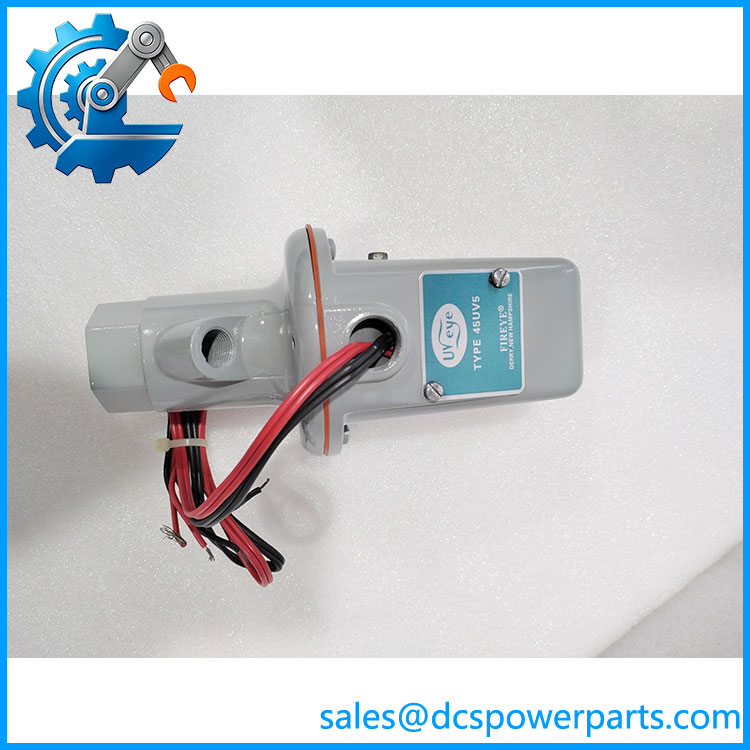
45UV5-1101
The 50 Hz electrical configuration and 1-inch BSP mounting connection distinguish this model from other 45UV5 versions. It is designed for compatible Fireye flame-safeguard systems used in boilers, process heaters, and industrial burners.
Application Scenarios & Field Pitfalls
The 45UV5-1101 is intended for burner installations where continuous flame supervision is required. Incorrect scanner alignment, unsuitable electrical frequency, or contaminated optical surfaces can cause unreliable flame signals and nuisance burner trips.
Typical application scenarios
- Industrial steam boiler flame monitoring.
- Natural-gas and propane burner supervision.
- Petroleum refinery process heaters.
- Industrial furnaces and combustion chambers.
- Diesel and light-oil burner safety systems.
Field-engineering precautions
- Verify the 50 Hz configuration. The 45UV5-1101 is designed for 50 Hz operation. Do not substitute a 60 Hz model without checking the associated control and power supply.
- Confirm the mounting thread. This model uses 1-inch BSP threads. The 45UV5-1000 uses NPT mounting, so the two should not be treated as mechanically interchangeable.
- Check scanner alignment. Aim the scanner toward the flame’s strongest UV-emitting region, generally near the flame base. Account for igniter position and burner air rotation.
- Maintain optical cleanliness. Inspect the quartz lens and purge-air arrangement. Contamination can reduce the detected UV signal.
- Never bypass self-checking protection. The electromagnetic shutter verifies detector operation. A defective shutter or detector should be investigated rather than bypassed.
- Use the correct AC waveform. Fireye specifies sinusoidal AC power. Non-sinusoidal waveforms can damage the scanner.
Related Products
- 45UV5-1000 — 60 Hz UV flame scanner with 1-inch NPT mounting. Different frequency and thread configuration.
- 45UV5-1010 — 60 Hz version with 1-inch BSP mounting.
- 45UV5-1103 — 50 Hz version with 1-inch NPT mounting.
- 45UV5-1101EX — 45UV5-1101 supplied in a hazardous-area housing with specified NEC/NEMA approvals.
- 45UV5-1101CEX — 45UV5-1101 in a hazardous-area enclosure with EExd IIC T6 / IP66 identification in the technical documentation.
- 55UV5 Series — Related Fireye UV flame scanners with a different scanner design; verify control compatibility.
- 4-290-2 UV Tube — Replacement UV detector tube for applicable 45UV5 engineering codes.
- 61-2275-2 Quartz Lens Assembly — Replacement optical component for compatible 45UV5 scanners.
Procurement note: When ordering Fireye 45UV5-1101, confirm the 50 Hz specification, 1-inch BSP mounting, engineering code, and compatibility with the installed Fireye control. If the burner operates in a hazardous area, specify the complete EX or CEX assembly rather than assuming the standard scanner housing provides hazardous-area protection.