Description
DEIF TAC-311DG | AC Current Transducer | Industrial Analog Signal Conversion
Key Technical Specifications
| Parameter | Specification |
|---|---|
| Manufacturer | DEIF |
| Model | TAC-311DG |
| Product Type | AC Current Transducer |
| Measurement | Sinusoidal AC current |
| Measurement Principle | Average measurement |
| Typical Measuring Current | 1.0–7.25 A AC, depending on configuration |
| Standard Output | 4–20 mA DC |
| Other Output Options | 0–5, 0–10, 0–20 mA DC; 0–10 V DC |
| Accuracy | Class 0.5 |
| Frequency Range | 45–65 Hz |
| Response Time | <300 ms |
| Galvanic Separation | 2200 V, 50 Hz, 1 minute |
| Auxiliary Supply | 24 VDC, 48–110 VDC, 88–220 VDC, or 110/230/440 VAC depending on ordered variant |
| Normal Ambient Temperature | -10 to +55°C |
| Operating Temperature | -25 to +70°C |
| Storage Temperature | -40 to +70°C |
| Case Protection | IP40 |
| Terminal Protection | IP20 |
| Mounting | 35 mm DIN rail or base |
| Dimensions | 55 × 75 mm |
| Approx. Weight | 0.4 kg |
The exact electrical configuration is important. DEIF documentation shows multiple TAC-311DG order numbers with different measuring-current ranges, output signals, and auxiliary supplies; therefore “TAC-311DG” alone does not identify the complete electrical configuration.
Product Introduction
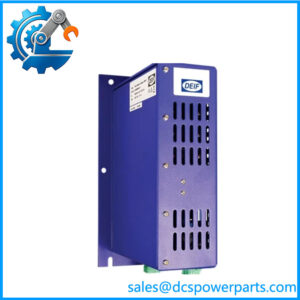
The DEIF TAC-311DG is a single-function AC current transducer designed to measure sinusoidal AC current and convert the measurement into a proportional DC analog output for PLCs, PCs, indicators, alarm systems, and other control equipment. The measurement circuit uses a transformer for galvanic isolation, followed by rectification, smoothing, and signal amplification.
The TAC-311DG is particularly useful in generator, switchboard, motor-control, and industrial power-monitoring installations where an AC current signal must be converted into a standard analog signal. Its Class 0.5 accuracy, compact 55 × 75 mm construction, and DIN-rail mounting make it suitable for cabinet-level signal conditioning. DEIF has now phased the model out, so exact configuration matching is critical when sourcing a replacement.
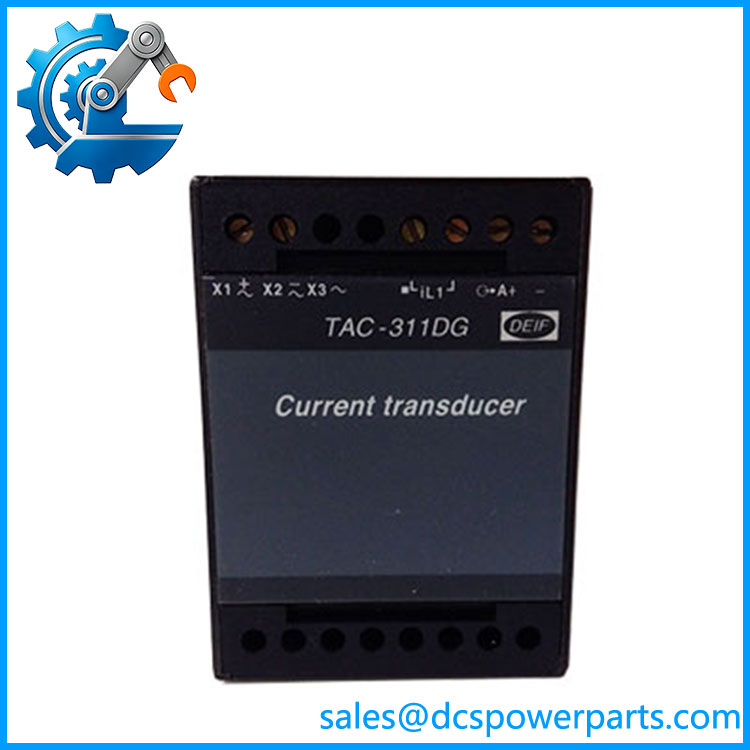
TAC-311DG
Application Scenarios & Field Pitfalls — Engineer’s Perspective
Engineering Pain Point
The most common procurement mistake with the is treating the model number as if it represents one universal electrical configuration. It does not. DEIF produced variants with different current ranges, analog outputs, and auxiliary supplies.
For example, the documentation identifies standard configurations such as 0–5 A AC input / 4–20 mA DC output, but other versions use 0–1 A or 0–6.5 A ranges and different auxiliary supplies.
Typical Applications
- Generator-set current monitoring
- Electrical switchboard instrumentation
- Motor current monitoring
- PLC/DCS analog-current signal conversion
- Marine and offshore power-control systems
- Alarm and indication systems requiring isolated AC-current measurement
Technical Pitfalls to Avoid
- Match the complete configuration, not just .
Check the unit’s top label for measuring current, output range, and auxiliary supply. A 0–5 A / 4–20 mA version cannot simply be substituted for every other variant. - Do not confuse with TAC-321DG.
Both measure AC current, but requires an auxiliary supply, while TAC-321DG is the corresponding version without a separate auxiliary supply. - Check the CT secondary circuit before energizing.
The transducer is intended for AC-current measurement and its input burden and overload capability depend on the configured measuring-current range. The documentation specifies 2× nominal current continuously, 10× for 10 seconds, and 40× for 1 second. - Do not assume the current output is always 4–20 mA.
variants are documented with 4–20 mA, 0–5 mA, 0–10 mA, 0–20 mA, and 0–10 V outputs. The output type must match the receiving PLC/DCS analog input.
Related Products
- DEIF TAC-321DG — AC current transducer without a separate auxiliary supply; electrically different from .
- DEIF TAV-311DG — AC voltage transducer with auxiliary supply; intended for voltage rather than current measurement.
- DEIF TAV-321DG — AC voltage transducer without a separate auxiliary supply.
- DEIF TAS-311DG — newer configurable transducer family covering current, voltage, frequency, and phase-angle measurements.
- DEIF TAS-321DG — configurable bidirectional current and power measurement transducer.
- DEIF TAS-331DG — transducer for active or reactive power measurement.
- DEIF SIM-Q — related DEIF electrical measurement/protection equipment, but with a different system role.
- DEIF TDG-210DG — signal-conversion product for DC signals rather than AC-current measurement.
DEIF’s current product documentation recommends newer TAS-family transducers for applications previously covered by the discontinued TAC/TAV generation, although the electrical function and configuration must be evaluated before treating one as a replacement.
Procurement Check
Before approving a replacement, verify:
- Exact model:
- DEIF order number, if available
- Measuring current: 0–1 A, 0–5 A, 0–6.5 A, or customized range
- Output: 4–20 mA, 0–5 mA, 0–10 mA, 0–20 mA, or 0–10 V
- Auxiliary supply voltage
- AC system frequency
- CT secondary rating
- Receiving PLC/DCS analog-input type
- Existing wiring and terminal allocation
- DIN-rail mounting arrangement
- Condition of the current transformer circuit
- Calibration/scaling in the receiving control system
Recommended procurement description:
DEIF AC Current Transducer, Single-Function Sinusoidal AC Current Measurement, Galvanically Isolated Analog Output, Class 0.5, 35 mm DIN-Rail Mount, Configuration to Be Verified by Nameplate/Order Number.
Important: DEIF officially lists as end-of-life and states that it currently has no direct replacement. For an existing installation, preserving the exact input/output/supply configuration is more important than selecting a newer transducer based only on nominal current range.