Description
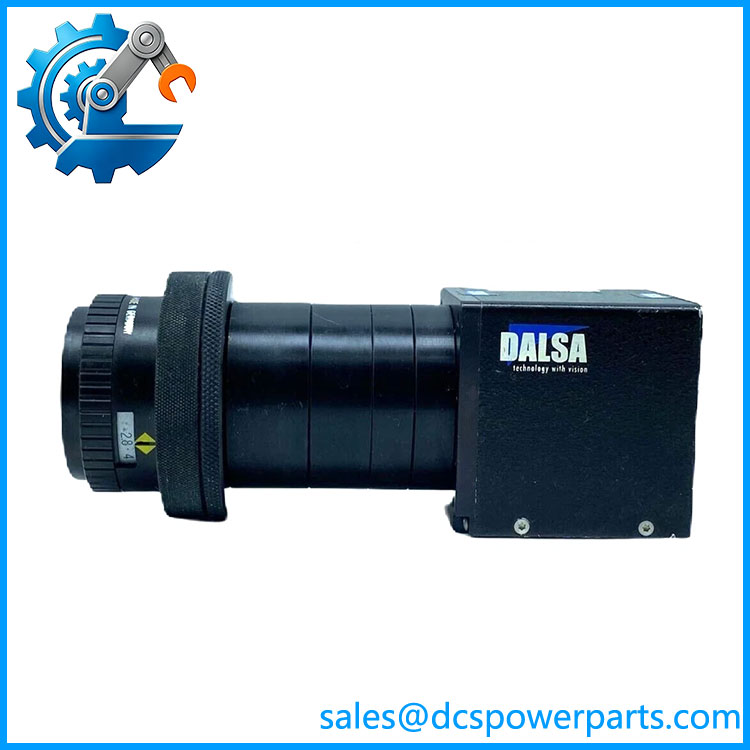
DALSA DS-21-04M15-12E Industrial Camera
Product Overview
The DALSA DS-21-04M15-12E belongs to DALSA’s 4M15 industrial vision camera platform, a high-resolution area-scan family designed for machine vision inspection, industrial metrology, electronics inspection, traffic imaging, and other applications requiring a relatively large image field with controlled acquisition timing. Documentation for the DS-21-04M15 identifies a 2048 × 2048 effective resolution, 10-bit operation, progressive scanning, two-tap Base Camera Link output, and a maximum acquisition rate of 16 frames per second.
The underlying 4M15 platform uses a 7.4 µm pixel pitch and supports selectable 8-bit or 10-bit digitization. The published product sheet specifies a 2 × 40 MHz data rate, programmable gain in 0.1 dB steps, programmable lookup tables, area-of-interest operation, and 1×1, 2×2, or 4×4 binning. These functions give the camera considerably more flexibility than a simple fixed-output industrial camera.
From an integration standpoint, the DALSA DS-21-04M15-12E is a Camera Link-era machine-vision device rather than a modern GigE Vision or USB3 Vision camera. The camera outputs image data through an MDR26 Camera Link connector and requires a compatible Camera Link frame grabber and acquisition software. Euresys and EPIX compatibility documentation continues to list the DS-21-04M15 family with Camera Link frame-grabber support.
One procurement caution is important: current secondary listings sometimes describe the exact DS-21-04M15-12E with specifications that conflict with the original 4M15 documentation. The verified 4M15 literature identifies the platform as 2048 × 2048, 7.4 µm pixels, 16 fps maximum, Base Camera Link, and 11–25 VDC supply. I would not use an unverified suffix-specific specification such as a different sensor resolution or temperature range without checking the physical label and original camera documentation.
Product Introduction
High-resolution inspection does not always require a modern smart camera. The DALSA DS-21-04M15-12E represents the earlier Camera Link approach: the camera concentrates on image acquisition while a separate frame grabber and host computer perform capture and processing. The documented 4M15 platform provides 2048 × 2048 imaging at up to 16 fps with a two-tap Camera Link output.
For a legacy machine-vision replacement, the critical compatibility question is not just resolution. The frame grabber, Camera Link configuration, cable, acquisition software, trigger method, lens mount, and power supply all need to match the existing installation.
Key Technical Specifications
| Parameter | Value |
|---|---|
| Product Model | DS-21-04M15-12E |
| Manufacturer / Brand | DALSA |
| Camera Family | Pantera / Falcon 4M15 family |
| Product Type | Monochrome Industrial Area-Scan Camera |
| Resolution | 2048 × 2048 pixels |
| Effective Resolution | 4 megapixels |
| Maximum Frame Rate | 16 fps |
| Pixel Size | 7.4 µm × 7.4 µm |
| Data Rate | 2 × 40 MHz |
| Video Output | Base Camera Link |
| Camera Link Configuration | Two-tap |
| Digitization | 8-bit / 10-bit selectable |
| Scan Type | Progressive scan |
| Exposure Control | Internal or external |
| Synchronization | Internal SYNC / external EXSYNC modes |
| Gain | Programmable, 0.1 dB steps |
| Gain Range | 0–15 dB nominal |
| Dynamic Range | 53 dB |
| Binning | 1×1, 2×2, 4×4 |
| Area of Interest | Supported |
| Lens Mount | M42 × 1 / C / F options documented for 4M15 family |
| Camera Dimensions | 56 × 56 × 56 mm |
| Mass | Approximately 184 g |
| Power Supply | +11 to +25 VDC |
| Power Dissipation | 6 W at 12 V; 7.1 W at 24 V |
| Control/Data Connector | MDR26 Camera Link |
| Power Connector | Hirose 6-pin |
| Operating Temperature | 0–40°C for the documented 4M15 platform |
The table uses the original 4M15 family documentation where the exact -12E suffix is not independently documented.
Major Features / Practical Advantages
4-megapixel area-scan imaging
The 2048 × 2048 image format gives the camera a large pixel count for a relatively compact industrial camera. The 7.4 µm square pixels provide a useful balance between spatial resolution and light collection for machine-vision applications.
For inspection work, this resolution is particularly useful when the camera must cover a reasonably large field of view while still resolving relatively small defects. Actual inspection resolution, of course, depends on lens selection, working distance, illumination, vibration, and the optical resolution of the complete system.
DALSA DS-21-04M15-12E
Base Camera Link interface
The camera uses Base Camera Link, with the documented 4M15 interface operating through two 40 MHz taps. This is a major integration consideration because the camera does not function like an Ethernet-based smart camera. A compatible Camera Link frame grabber is required.
EPIX specifically lists a PIXCI frame-grabber configuration for the DALSA Pantera SA DS-21-04M15, while Euresys also provides a DS-21-04M15 Camera Link configuration package.
2048 × 2048 progressive scan
The 4M15 platform uses progressive scanning and a 2048 × 2048 pixel image. This is useful for machine-vision applications where the complete frame must be captured without the interlaced-field complications found in older video architectures.
Up to 16 frames per second
The documented maximum frame rate is 16 fps for the full 2048 × 2048 image. Windowing and partial scanning can be used where the application does not require the complete sensor area, potentially improving acquisition throughput.
Do not confuse this with a 16 kHz line-scan rate. The DS-21-04M15 is an area-scan camera.
Selectable digitization
The 4M15 documentation provides selectable 8-bit or 10-bit digitization. Ten-bit acquisition provides 1,024 nominal intensity levels, which can be useful when the inspection algorithm needs more gray-level information than an 8-bit pipeline provides.
Whether the host application actually preserves that additional information depends on the Camera Link configuration, frame grabber, driver, and image-processing software.
Programmable gain and LUT
Programmable gain is specified in 0.1 dB increments, with a nominal 0–15 dB gain range. Programmable lookup tables can also be used for gamma correction and improved output linearity.
These functions are useful when adapting one camera to different illumination conditions without changing the basic mechanical installation.
Binning and area-of-interest operation
The documented camera supports 1×1, 2×2, and 4×4 binning together with area-of-interest capability. These modes allow the acquisition workload to be adjusted when the application does not need the complete sensor area.
There is a practical tradeoff: binning changes the effective spatial sampling, so it should be evaluated against the smallest defect or feature that the inspection system needs to resolve.
Internal and external exposure control
The DS-21-04M15 documentation describes internal synchronization as well as external exposure control. Matrox’s Camera Link application note documents continuous, pseudo-continuous, and asynchronous-reset modes using the camera’s Smart EXSYNC behavior.
This makes the camera suitable for systems where image acquisition needs to be coordinated with motion, illumination, or an external inspection trigger.
Compact mechanical format
The documented 4M15 body measures approximately 56 × 56 × 56 mm and weighs about 184 g. That compact format can be useful when replacing an older camera in a constrained inspection enclosure.
The lens interface must still be checked carefully because the 4M15 documentation identifies multiple mount configurations. Do not assume that every DS-21-04M15 variant has the same factory lens mount.
Related Products
- DALSA DS-21-04M15 — Core monochrome 4M15 camera platform. This is the principal family reference for the DS-21-04M15-12E.
- DALSA DS-22-04M15 — Color version of the 4M15 platform, using the corresponding color sensor configuration rather than the monochrome DS-21 family.
- DALSA DS-21-01M60 — Pantera monochrome camera with a different resolution/frame-rate configuration; it requires a different acquisition configuration from the 4M15.
- DALSA DS-1A-01M30 — Pantera monochrome camera from a different performance class; not a direct optical or acquisition substitute.
- EPIX PIXCI-E4TX2 — PCI Express Camera Link frame-grabber family documented as compatible with the DS-21-04M15.
- EPIX CL1-DS-21-04M15 — PCI Camera Link frame-grabber configuration specifically associated with the DS-21-04M15.
- Euresys Grablink Base — Camera Link frame-grabber platform with a documented DS-21-04M15 configuration package.
- Matrox Helios eCL/XCL — Camera Link acquisition platform with a documented DS-21-04M15 interface configuration.
FAQ
Is the DALSA DS-21-04M15-12E a Camera Link camera?
Yes. The DS-21-04M15 family is documented with a Base Camera Link interface, using a two-tap configuration. A compatible Camera Link frame grabber is therefore part of the complete acquisition system.
What is the camera resolution?
The documented 4M15 platform provides 2048 × 2048 pixels, equivalent to approximately 4 megapixels.
Can I use a modern GigE Vision frame grabber with it?
Not directly. The documented interface is Camera Link rather than GigE Vision. A Camera Link acquisition interface is required unless the system incorporates a separate protocol-conversion architecture.
Is this a line-scan camera?
No. The DS-21-04M15 is an area-scan camera. The full-frame specification is 2048 × 2048 at up to 16 fps.
Can I run the camera at 10-bit?
The 4M15 documentation specifies selectable 8-bit or 10-bit digitization. The acquisition software and frame-grabber configuration must also be set appropriately if the application is to preserve the 10-bit data.
Does it support external triggering?
Yes. The documented platform supports internal or external exposure control, and Matrox’s interface documentation describes Smart EXSYNC operation for externally initiated acquisition modes.
What power supply does the camera require?
The original 4M15 product sheet specifies a single 11–25 VDC supply. It lists power dissipation of approximately 6 W at 12 V and 7.1 W at 24 V.
Does the exact DS-21-04M15-12E support 2048 × 2048 at 16 fps?
The DS-21-04M15 family is documented at 2048 × 2048 and 16 fps. I would not treat every suffix-specific listing as authoritative, however. For the exact -12E unit, confirm the camera label and configuration documentation before committing to a replacement based on a different suffix. The original family documentation uses DS-21-04M15 as the example part number.
Does firmware v3.1 apply to this camera?
There is no reliable evidence that a generic “firmware v3.1” designation can be inferred from the DS-21-04M15-12E model number. Camera configuration, acquisition drivers, and frame-grabber compatibility should be checked against the actual installed vision system.
Can I hot-swap this camera?
Do not assume hot-swap capability. Camera Link systems normally involve separate camera power, data, trigger, and frame-grabber connections. Follow the machine-builder’s electrical isolation and maintenance procedure before disconnecting an installed camera.
Procurement Note
The DALSA DS-21-04M15-12E should be purchased as a legacy machine-vision component, with compatibility checked at the system level. The important matching parameters are not limited to the camera model. Confirm the exact camera suffix, sensor configuration, monochrome/color requirement, lens mount, Camera Link tap configuration, frame-grabber model, acquisition software, cable arrangement, trigger method, and supply voltage.
The original 4M15 documentation establishes the platform at 2048 × 2048, 16 fps, 7.4 µm pixels, Base Camera Link, 8/10-bit digitization, and +11 to +25 VDC power.
There is a particular reason to be cautious with this part number: current secondary listings for DS-21-04M15-12E provide inconsistent sensor, resolution, dimensions, temperature, and power information. One current listing, for example, describes a different 2048 × 1088 configuration, which conflicts with the original 4M15 documentation. I would not use those conflicting values for engineering replacement decisions.
For surplus or refurbished procurement, request a clear photograph of the camera’s complete model label, connector panel, and lens mount. A camera that looks identical externally can still have a different sensor configuration or interface revision. More importantly, verify that the existing Camera Link frame grabber has a supported configuration for the exact camera variant before taking the camera offline.