Description
Key Technical Specifications
| Parameter | Specification |
|---|---|
| Product Designation | NSAC-1 |
| Manufacturer / Technology | Nittan; associated with Consilium / Salwico |
| Product Type | Addressable fire alarm control system |
| Primary Application | Marine fire detection and alarm |
| Detection Architecture | Analog addressable |
| Detector Loop Supply | 24 VDC |
| Main Power Supply | 230 VAC ±10%, 50/60 Hz |
| Backup Supply | 24 VDC battery |
| Loop Cable Distance | Up to 1,200 m without a signal repeater, according to installation documentation |
| Signal Repeater | Required when the specified cable distance exceeds 1.2 km |
| Conventional Detector Integration | Supported through ZC10 zone circuit board |
| Configuration Software | SYSTEM CREATOR |
| Configuration Interface | Serial connection to the BC1 base card |
| Control Unit Boards | BC1 base card, CPUC2 processor card, PC1 panel card |
| Operator Interface | LCD display and touch-panel keypad |
| Alarm Functions | Fire, fault, zone/detector indication, alarm routing |
| External Control | Configurable relay and control outputs |
| Enclosure Protection | Depends on the specific control cabinet; verify exact assembly |
| Operating Temperature | Not confirmed for the complete control unit |
The electrical supply, loop arrangement, cable-distance guidance, and internal control-unit architecture are drawn from the NSAC-1 installation and reference manuals. Exact specifications depend on the cabinet and board configuration.
Product Introduction
Consilium Salwico NSAC-1 Marine Fire Alarm System
The Consilium / Salwico NSAC-1 is an addressable fire detection and alarm system designed for marine installations. It monitors detector loops, identifies individual alarm locations, and manages fire, fault, and external alarm functions through a central control unit.
Its architecture includes processor, base, and operator-panel circuit boards, with configurable detector and zone arrangements. The system’s original configuration data and detector addressing are important when maintaining or replacing legacy equipment.
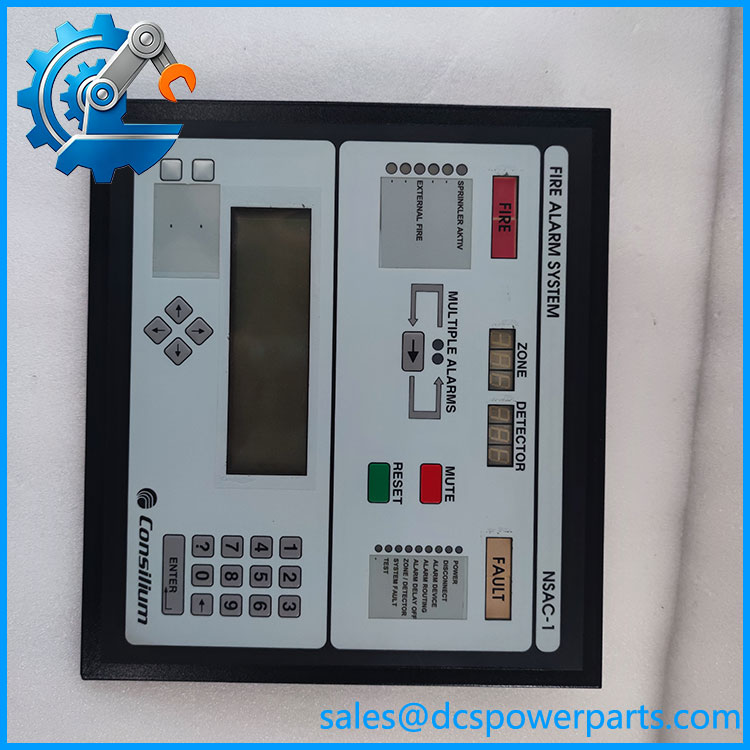
NSAC-1
Application Scenarios & Field Pitfalls (Engineer’s Perspective)
A fault in a marine fire alarm system must be treated differently from an ordinary industrial control fault. Incorrect loop wiring, missing detector addresses, or an incomplete configuration transfer can compromise fire detection coverage.
Typical application scenarios
- Commercial vessels: Monitors smoke, heat, and other compatible fire detectors across designated vessel zones.
- Passenger ships: Provides centralized alarm indication and location identification.
- Engine-room protection: Supports fire detection and alarm functions in machinery spaces.
- Offshore installations: Provides addressable fire monitoring and configured external alarm outputs.
Field pitfalls to check before replacement
1. Configuration backup: Preserve the existing NSAC-1 configuration before replacing the control unit or processor boards. SYSTEM CREATOR is required for configuration work and is restricted to authorized Nittan personnel. A replacement panel without the correct configuration may not recognize the installed detector network.
2. Detector loop wiring: Check loop polarity, cable condition, termination arrangements, and signal-repeater requirements. The installation manual specifies a maximum cable distance of 1,200 meters without a repeater. Do not assume that a replacement cable or detector arrangement will preserve the original loop behavior.
3. Power and battery supervision: Verify the 230 VAC supply, 24 VDC battery circuit, charger operation, and automatic changeover. Confirm that the control unit reports normal power and battery status after maintenance.
Safety requirement: Fire alarm circuits must remain under approved fire-watch or compensating safety procedures during maintenance. Do not return the system to service until detector loops, alarm indications, and configured external outputs have been tested.
Related Products and Components
| Model | Description | Relationship |
|---|---|---|
| BC1 | Base card | Main internal interface board |
| CPUC2 | Processor card | Central system processing |
| PC1 | Panel card | LCD and operator-panel interface |
| ZC10 | Conventional detector zone card | Integrates conventional detection circuits |
| NS-AIN1 | Addressable interface loop unit | Connects conventional and intrinsically safe detectors in supported systems |
| NS-SCI | Short-circuit isolator | Protects addressable detector loop sections |
| N11891 | NS-SCI complete part number | Short-circuit isolator reference |
| N11892 | NS-SCI PCB part number | Isolator circuit-board reference |
| NS-DHG1 | Heat detector | Detector listed in NSAC-1-related marine equipment references |
These are documented system components or associated detector products, not interchangeable replacements for the complete control system.
Procurement and Quality Control Notes
is a legacy marine fire detection platform. Before ordering, establish whether the requirement is for the complete control unit or a specific internal PCB. The designation alone is insufficient to identify the exact replacement assembly.
Request the following information:
- Complete control-unit nameplate and cabinet photographs.
- PCB identifiers and revision markings, especially BC1, CPUC2, and PC1.
- Existing detector-loop configuration and device count.
- Original SYSTEM CREATOR configuration backup, if available.
- Main supply and battery-charger condition.
- LCD, keypad, alarm indicators, and fault indications test results.
- Detector-loop communication and alarm activation test records.
- Applicable vessel classification and approval documentation.
Important: A replacement control panel is not automatically compatible with every legacy detector or loop arrangement. Confirm the installed detector technology, configuration data, and approved marine system design before procurement.