Description
Product Overview
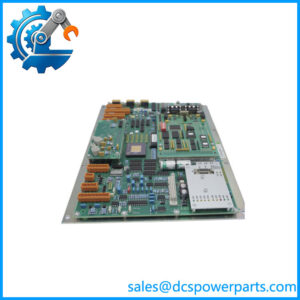
The Basler Electric DECS-250-LN1SN1N is a style-coded version of the DECS-250 Digital Excitation Control System, designed for excitation regulation and protection in synchronous generator applications. Installed in the excitation control circuit, it adjusts field excitation in response to sensed electrical conditions, helping maintain generator terminal voltage and manage reactive power during changing loads and parallel operation. The DECS-250 platform provides automatic voltage regulation, field-current regulation, VAR and power-factor control, generator metering, configurable protection, and programmable logic. The exact functions enabled in an individual unit depend on its ordered configuration and system setup.
The DECS-250 uses a PWM power stage and supports nominal excitation outputs of 32, 63, or 125 V DC, with a family-rated continuous output of 15 A DC. Basler documentation also describes protection and limiting functions such as overexcitation, underexcitation, stator-current, and underfrequency or volts-per-hertz limiting. These functions are relevant to generator commissioning and operation, but their availability and settings must be checked against the unit’s configuration and application requirements rather than assumed from the base model name.
For replacement procurement, the complete Basler Electric DECS-250-LN1SN1N style number is important. The DECS-250 family includes variants with different options, so matching only “” can leave gaps in control power, communications, terminal arrangements, or enabled features. Before installation, compare the identification label, wiring drawings, excitation-system design, firmware, and saved configuration with the existing unit. Basler’s BESTCOMSPlus software supports setup and monitoring; a replacement should be commissioned by qualified personnel with the original settings backed up and protection limits verified.
Product Introduction
The Basler Electric -LN1SN1N is intended for synchronous generator excitation systems that require digital voltage regulation, reactive power control, and generator protection. Typical application environments include industrial power generation, standby generator plants, and utility-parallel generation systems.
The family provides a 15 A DC continuous excitation output rating and supports AVR, VAR, and power-factor regulation. Confirm the exact excitation voltage, control-power requirements, communication options, and installed firmware before using this model as a replacement.
Key Technical Specifications
| Parameter | Specification |
|---|---|
| Manufacturer | Basler Electric |
| Model | DECS-250-LN1SN1N |
| Product family | DECS-250-LN1SN1N |
| Product type | Digital excitation control system |
| Primary application | Synchronous generator excitation and regulation |
| Regulation modes | AVR, VAR, power factor; confirm configured functions |
| Excitation output stage | Pulse-width modulated (PWM) |
| Continuous output current | 15 A DC, family rating |
| Nominal output voltage | 32, 63, or 125 V DC, depending on configuration |
| Control software | BESTCOMSPlus |
| Programmable logic | BESTLogicPlus |
| Local communication | USB Type B is documented for the family |
| Other communications | RS-485 / Modbus RTU and optional interfaces, depending on configuration |
| Protection functions | Generator protection and excitation limiting; verify enabled functions |
| Operating temperature | Confirm against the applicable manual revision and unit configuration |
| Installation method | Panel installation; verify mounting and terminal details against the manual |
| Condition | Must be confirmed for the specific supplied unit |
Specifications above are based on family documentation. The exact meaning of each character in LN1SN1N and the corresponding option set should be checked against Basler’s style-number documentation and the product nameplate.
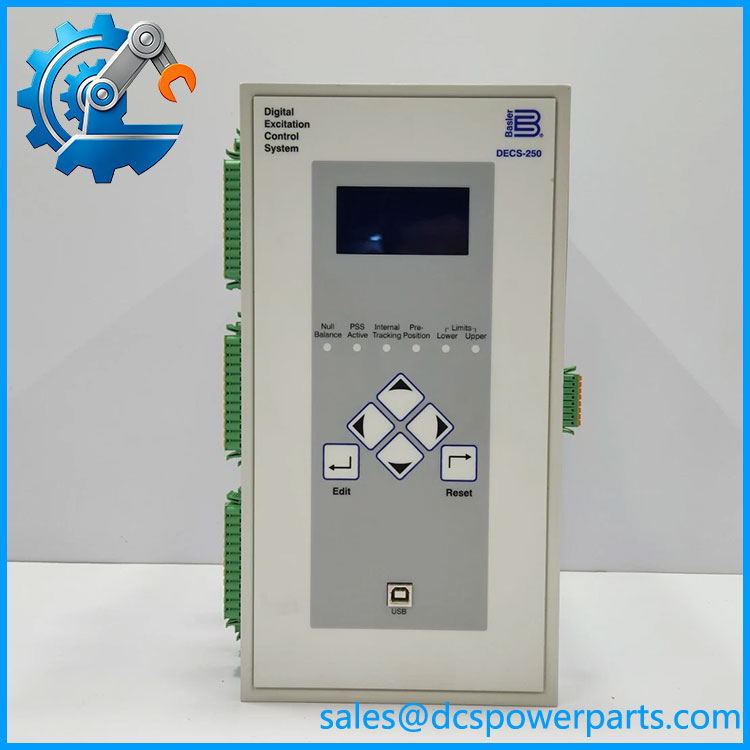
DECS-250-LN1SN1N
Related Products
These products belong to related generator-control or excitation-control equipment families. They are not automatically interchangeable with the -LN1SN1N.
- Basler DECS-250N — Related excitation-control model; verify its architecture and configuration before considering a substitution.
- Basler DECS-200 — Earlier digital excitation-control family; replacement suitability depends on the installed excitation system.
- Basler DECS-150 — Digital excitation controller for applications with different functional and configuration requirements.
- Basler DECS-400 — Excitation-control product family for generator applications; assess the full system interface before retrofit.
- Basler DGC-2020 — Generator controller focused on generator monitoring and control functions, rather than serving as a direct excitation-controller substitute.
- Basler DGC-2020ES — Generator-control equipment for related standby-power applications; verify the intended system role.
- Basler DGC-2020HD — Generator controller variant; not a drop-in replacement for a .
- Basler AEM-2020 — Analog expansion module for supported Basler systems; confirm the required interface and application compatibility.
- Basler CEM-2020 — Contact expansion module for supported control systems; verify connection and software support.
Basler identifies these products and accessories within its generator-control and excitation-control portfolio.
Frequently Asked Questions
1. Can I hot-swap this?
Do not assume hot-swap capability. The is part of an excitation-control system, and removing it during operation can affect generator voltage regulation and protection. Follow the equipment-specific shutdown, isolation, and replacement procedure, including the plant’s electrical safety requirements.
2. Is the -LN1SN1N compatible with my existing generator?
Compatibility depends on the generator’s excitation arrangement, field requirements, sensing transformers, control wiring, protection settings, and ordered options. Compare the complete style number with the existing unit and confirm the system design before ordering.
3. Does the replacement require firmware or configuration work?
Potentially. Firmware and configuration differences can affect behavior or compatibility. Back up the existing settings where possible, verify the installed firmware and software version, and validate regulation modes, protection limits, I/O assignments, and communications during commissioning. Basler cautions that firmware-version differences can create compatibility issues.
4. Can I transfer the existing logic and settings?
Do not assume a configuration file can be transferred without modification. Check software and firmware compatibility, enabled options, programmable logic, and I/O mapping. After loading settings, test the control scheme and protective functions against the approved commissioning procedure.
5. How can I verify that a new-surplus unit is authentic?
Request clear photographs of the nameplate, complete style number, serial number, terminals, and packaging. Ask for traceable sourcing and any available inspection or functional-test records. “New surplus” describes a claimed condition; it does not by itself establish authenticity or successful operation.
6. What should be checked before installation?
Verify the full model code, auxiliary power requirements, excitation output rating, sensing inputs, wiring, communication options, grounding, mounting, and firmware. Confirm the unit’s configuration against the generator and excitation-system drawings before energizing it.
7. What warranty and test documentation should accompany the unit?
Confirm the warranty period and its coverage in writing with the supplier. For used or surplus equipment, request the actual test scope, test date, and results. A visual inspection alone does not prove correct voltage regulation, field forcing, protective operation, or communication performance.