Description
Product Overview
In a building control panel with many status points and switched loads, distributing control across several smaller controllers can increase wiring and commissioning effort. The Alerton VLC-16160-E addresses high-point-count applications with 16 universal inputs and 16 hot-switched triac binary outputs in one programmable field controller. Its inputs support specified thermistors, dry contacts, voltage and current signals, and dry-contact pulse signals. The triac outputs are intended for compatible 24 VAC loads, subject to the controller’s output and total power limits.
The VLC-16160-E uses BACnet MS/TP communication over an RS-485 network and supports Alerton’s VisualLogic programming environment with BD4 DDC files. It is suited to installations such as central plant systems, lighting control panels, and damper motor control where a relatively large number of binary outputs must be managed through a building automation network. During replacement or expansion, verify the existing application file, firmware compatibility, terminal assignments, BACnet settings, and the electrical load connected to each output. The standard VLC-16160-E should also be distinguished from the VLC-16160-E-S smoke-control variant, which has separate ordering and certification considerations.
Key Technical Specifications
| Parameter | Specification |
|---|---|
| Product model | VLC-16160-E |
| Manufacturer | Alerton / Honeywell |
| Product type | Programmable BACnet field controller |
| Supply voltage | 24 VAC, 50–60 Hz |
| Minimum power requirement | 18 VA, as specified in the standard-model datasheet |
| Maximum power across binary-output loads | 100 VA |
| Universal inputs | 16 |
| Supported input types | 3 kΩ Ibex or 10 kΩ Type II thermistors, dry contacts, 0–20 mA, 0–5 V, 0–10 V, and dry-contact pulse |
| Current input | External 250 Ω resistor required for 0–20 mA inputs |
| Pulse input | Maximum 100 Hz; IN-0 does not support pulse input |
| Binary outputs | 16 hot-switched triac outputs |
| Output rating | 24 VAC, 500 mA continuous; 800 mA AC RMS for 60 ms |
| Analog outputs | None |
| External sensor power | 20 VDC ±10%, maximum 100 mA |
| Communication interface | EIA-485 / RS-485, twisted shielded pair |
| Communication protocol | BACnet MS/TP, master |
| Supported baud rates | 9.6, 19.2, 38.4, 76.8, and 115.2 kbps |
| Programming | Alerton VisualLogic; BD4 DDC format |
| Processor | 32-bit ARM Cortex-M4F, 80 MHz |
| Non-volatile flash | 512 MB, per published datasheet |
| Mounting | Screw mounting |
| Terminals | Removable screw terminals, 14–24 AWG |
| Dimensions | Approximately 178 × 127 × 38 mm |
| Operating temperature | 0 to 49°C |
| Relative humidity | 5–85%, non-condensing |
These specifications are for the standard VLC-16160-E. The manufacturer also publishes e -S datasheet for smoke-control applications. Verify the full model suffix and applicable documentation before ordering or installation.
Important power limitation: The 100 VA maximum applies across the binary-output loads. Do not calculate each output’s maximum load independently and assume all 16 outputs can operate at that rating simultaneously. The combined controller and load demand must remain within the published limit.
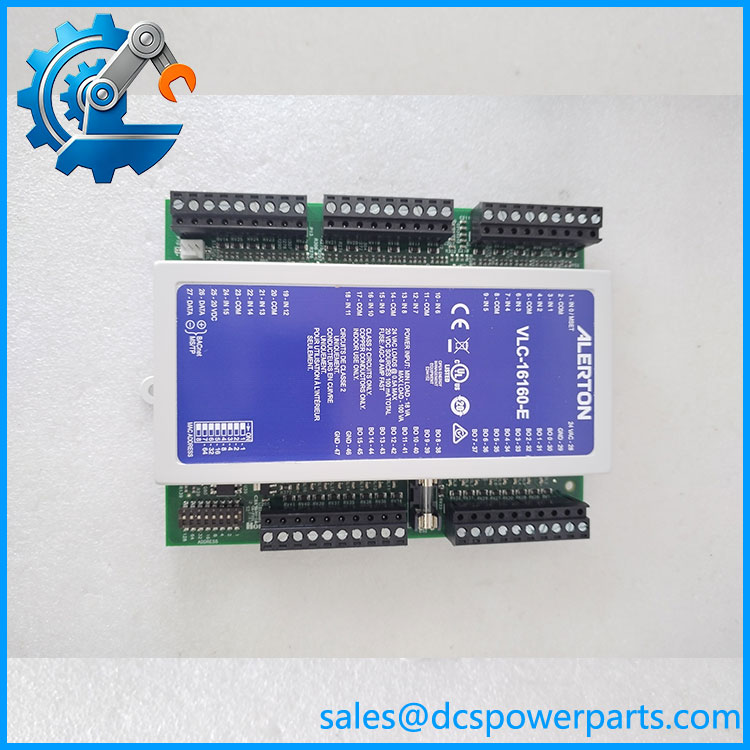
VLC-16160-E
Major Features and Advantages
1. High-density input monitoring
Sixteen universal inputs allow the controller to collect temperature, equipment status, and supported voltage or current signals within a single field device. This arrangement can reduce the number of separate controllers needed in applications with many monitoring points.
Input flexibility does not eliminate the need for correct configuration. Confirm the sensor resistance curve and signal range, and install the specified 250 Ω resistor for 0–20 mA inputs. Pulse-based signals must be assigned to a supported input rather than IN-0.
2. Sixteen triac outputs for switched loads
The 16 hot-switched triac outputs support compatible 24 VAC binary control loads. They are useful for applications that require numerous switched commands, including damper control and selected building equipment.
The published rating is 500 mA continuous per output, with 800 mA AC RMS specified for 60 milliseconds. The controller also has a 100 VA maximum across binary-output loads. Engineers must check both individual output ratings and the combined power demand.
3. BACnet MS/TP integration
The RS-485 interface supports BACnet MS/TP communication at baud rates up to 115.2 kbps. This enables the controller to exchange supported data with compatible building automation equipment.
Network commissioning should include verification of the device instance, MAC address, baud rate, RS-485 polarity, shield termination practice, and network topology. A powered controller may still appear offline if its communication parameters do not match the network.
4. Programmable control logic
The controller supports Alerton’s VisualLogic toolset and BD4 DDC application format. Site-specific logic can coordinate inputs and outputs according to the building’s control sequence.
For maintenance work, preserve the original DDC file and record the controller’s configuration before replacement. Confirm that the software and firmware are appropriate for the target unit before attempting to download an application.
5. Non-volatile program storage
The published datasheet identifies non-volatile flash memory for program storage. This supports retention of application data without relying solely on continuous power to maintain stored logic. It does not mean that every replacement unit will arrive with the required project-specific DDC file installed.
Application Scenarios and Common Pain Points
| Application | Typical requirement | Engineering consideration |
|---|---|---|
| Central plant systems | Monitor numerous equipment states and operate switched devices | Validate I/O mapping and the control sequence |
| Lighting control panels | Manage multiple switched control points | Verify load compatibility and total VA demand |
| Damper motor control | Coordinate commands to compatible 24 VAC devices | Confirm actuator type and output current |
| Building equipment panels | Combine sensor monitoring with binary control | Match input configuration to field devices |
| Controller replacement | Restore an existing multi-point control application | Check firmware, DDC file, terminal mapping, and BACnet settings |
Common field problems
- A field input reads incorrectly: Check the sensor type, signal range, wiring, and current-input resistor.
- An output does not switch the load: Verify 24 VAC supply, output wiring, load current, and whether the load is compatible with triac switching.
- Several outputs fail under simultaneous demand: Check the combined load against the 100 VA limit and inspect the supply capacity.
- The controller cannot communicate with the building network: Check RS-485 wiring, network addressing, baud rate, and termination.
- A replacement does not execute the required logic: Confirm the correct BD4 DDC file and firmware compatibility.
- A smoke-control project specifies this model: Confirm whether the application ree -S variant and its applicable approvals. Do not assume thd has the same certification status.
Related Products
These models belong to the broader Alerton VisualLogic controller family. Their functions and I/O arrangements differ, so they should be treated as comparison options rather than automatic replacements.
| Model | Main distinction |
|---|---|
| VLC-1600-E | Related controller with 16 universal inputs; output configuration differs |
| VLC-1188-E | 11 universal inputs, 8 hot-switched triac outputs, and 8 analog outputs |
| VLC-853-E | 8 universal inputs, 5 triac outputs, and 3 analog outputs |
| VLC-550-E | 5 universal inputs and 5 hot-switched triac outputs |
| VLC-651R-E | Related controller with a combination of triac and isolated relay outputs |
| VLC-660R-E | Related programmable controller in the VisualLogic family |
| -S | Smoke-control-specific variant; verify ordering code and certification requirements |
| VAV-SD-E | Controller intended for single-duct variable-air-volume applications |
The model distinctions above are based on published VisualLogic product-family information. Confirm exact hardware and software compatibility before substituting any controller.
Engineer’s Guide: Three Checks Before Ordering
1. Confirm the exact suffix. Check whether the requirement is for te -S smoke-control variant. Certification and project approval requirements may differ.
2. Calculate output loading. Verify the current requirement of each connected device and the combined binary-output load. Do not exceed the controller’s 100 VA maximum across binary-output loads.
3. Verify the application and network configuration. Confirm the DDC file, firmware requirements, input/output assignments, BACnet address, baud rate, and wiring before commissioning.
Safety note: The triac outputs are specified for compatible 24 VAC loads, not direct switching of line-voltage equipment. Use appropriately rated interface hardware where the field load requires it.
Frequently Asked Questions
1. What is tn used for?
It is a programmable building automation controller intended for applications such as central plant systems, lighting panels, damper motor control, and other installations with multiple input and switched-output points.
2. How many inputs and outputs does it have?
Thd has 16 universal inputs and 16 hot-switched triac binary outputs. It has no dedicated analog outputs.
3. What power supply does it require?
The standard-model datasheet specifies 24 VAC at 50–60 Hz, with an 18 VA minimum requirement and a 100 VA maximum across binary-output loads. Confirm the connected load calculation and use the applicable model documentation.
4. Does it support BACnet MS/TP?
Yes. It communicates over RS-485 using BACnet MS/TP, with supported baud rates up to 115.2 kbps. Correct network configuration is necessary for reliable integration.
5. Can it replace an older or VLC-16160C3?
The published datasheet describes backward compatibility with older and VLC-16160C3 models. Nevertheless, check the installed wiring, DDC application, firmware requirements, and commissioning procedure before replacing the controller.
 Information And Communications Technology
e suitable for smoke-control systems?
Do not assume that the standard model is approved for a smoke-control application. Alerton publishes e -S model specifically associated with UL 864/UUKL smoke-control systems. Verify the required model, project approval, and applicable certification documentation.
7. What should be checked when purchasing a replacement?
Confirm the complete model number, hardware condition, input and output operation, BACnet communication, DDC application requirements, warranty terms, and lead time. For a used or refurbished unit, request documented functional-test results and confirmation of the included hardware.