Description
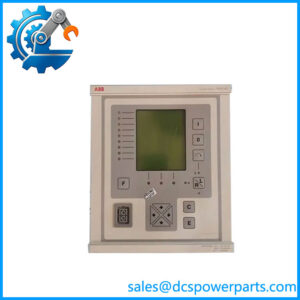
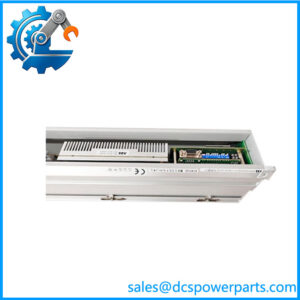
ABB UNITROL 1020 3BHE036163R6206
Product Overview
The ABB UNITROL 1020 3BHE036163R6206 is a digital automatic voltage regulator within ABB’s UNITROL 1000 excitation platform. UNITROL 1020 is designed for small and medium synchronous generators and industrial machines, using microprocessor control and IGBT power electronics to regulate the excitation system. Compared with the UNITROL 1010, the 1020 extends the continuous excitation-current capability to as much as 20 A DC under specified operating conditions.
The ABB UNITROL 1020 3BHE036163R6206 is therefore not a conventional PLC output module or general-purpose motor controller. It sits directly in the generator excitation chain, controlling field excitation so that generator voltage and reactive-power behavior remain within the required operating limits. ABB documents AVR, field-current regulation, power-factor and VAR regulation, automatic synchronization, load sharing, rotating-diode monitoring, communication functions, and dual-channel capability within the UNITROL 1020 platform.
For plant maintenance, the distinction matters. Replacing a UNITROL 1020 is not simply a matter of matching the enclosure and nominal current rating. The excitation source, generator voltage/current measurements, field characteristics, regulation parameters, limiters, I/O assignments, communication interface, and software configuration all affect commissioning. The exact 3BHE036163R6206 ordering number should remain on the purchase specification because ABB uses configuration-specific ordering codes across the UNITROL 1000 family.
Product Introduction — Non-Templated
Generator excitation problems rarely stay confined to the AVR cabinet. A poorly matched replacement can affect voltage buildup, reactive-power sharing, limiter operation, synchronization, and ultimately generator stability. UNITROL 1020 3BHE036163R6206 belongs to the excitation-control layer where those functions are directly managed.
With IGBT power electronics, digital regulation, dual-channel capability, event/data logging, and integrated synchronization and load-sharing functions, the UNITROL 1020 provides considerably more than basic voltage regulation. ABB positions the platform for industrial, marine, diesel, gas, hydro, and other synchronous-machine applications.
Key Technical Specifications
| Parameter | Specification |
|---|---|
| Product Model | UNITROL 1020 |
| ABB Ordering Number | 3BHE036163R6206 |
| Manufacturer | ABB |
| Product Family | UNITROL 1000 |
| Product Type | Digital automatic voltage regulator / excitation controller |
| Technology | Microprocessor control with IGBT power electronics |
| Excitation Input, AC | 0–250 VAC nominal; maximum sinusoidal input 300 VAC |
| Excitation Input, DC | 0–300 VDC nominal; maximum 420 VDC |
| Auxiliary AC Supply | 3-phase 9–250 VAC or single-phase 16–250 VAC nominal |
| Auxiliary DC Supply | 18–300 VDC nominal |
| Maximum Auxiliary Power Consumption | 40 W |
| Excitation Output | Up to 20 A DC continuous at specified conditions |
| Short-Time Excitation Current | Up to 38 A for 10 seconds at 55°C |
| Voltage Regulation Accuracy | 0.2% at 25°C |
| AVR Response Time | <20 ms with three-phase measurement; <50 ms with single-phase measurement |
| Excitation Current Measurement | 0–38 A DC |
| Excitation Current Measurement Accuracy | ±1% after digital filtering |
| PWM Limitation | 0.5–99% |
| Ambient Temperature | -40°C to +70°C |
| Maximum Heat-Sink Temperature | 90°C |
| Protection / Enclosure | IP20 device; cabinet installation |
| Configuration Software | CMT 1000 |
| Exact Hardware Options | Configuration dependent on ordering number |
ABB’s published technical data supports the input ranges, 20 A maximum continuous excitation output under specified conditions, 38 A/10-second overload capability at 55°C, 0.2% voltage-regulation accuracy at 25°C, and response times listed above.
The output rating needs one qualification: 20 A is not a universal rating independent of temperature and installation conditions. ABB’s documentation gives derating and installation conditions, including lower continuous-current capability at elevated temperature. An external capacitor or improved cooling may also be required for certain operating ranges.
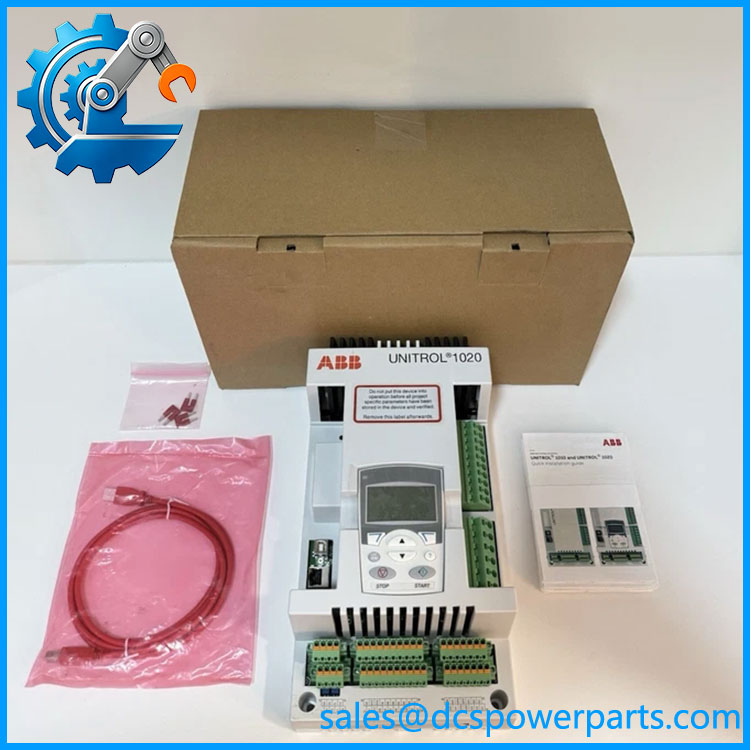
UNITROL 1020-FULL 3BHE030579R0106
Major Features / Practical Advantages
Digital Automatic Voltage Regulation
The primary role of the UNITROL 1020 is automatic generator voltage regulation. Its digital controller continuously processes generator measurements and adjusts excitation through its IGBT power stage.
The documented regulation accuracy is 0.2% at 25°C, while the three-phase measurement response time is specified below 20 ms. Those figures matter during load changes and grid disturbances because excitation response directly affects generator voltage behavior.
Up to 20 A Continuous Excitation Output
UNITROL 1020 extends the UNITROL 1010 architecture to applications requiring higher field current. ABB specifies up to 20 A DC continuous excitation output under the applicable thermal conditions. At 55°C, the published technical data identifies 15 A continuous output as the standard condition, with 20 A achievable under specified improved-cooling/external-capacitor arrangements.
That distinction is important when sizing a replacement. A nameplate stating “UNITROL 1020” does not eliminate the need to check the actual field-current requirement and cabinet cooling.
Multiple Regulation Modes
UNITROL 1020 supports several regulation modes, including:
- Automatic voltage regulation (AVR)
- Field-current regulation (FCR)
- Power-factor regulation
- Reactive-power / VAR regulation
- Limiter functions associated with machine operating boundaries
ABB’s current product information identifies these regulation capabilities as part of the UNITROL 1020 platform.
This allows one excitation controller to operate under different generator operating conditions rather than relying on a simple fixed voltage-regulation loop.
Dual-Channel Capability
UNITROL 1020 incorporates support for redundant control channels. ABB describes a main and redundant channel arrangement intended to support bumpless transfer and improve availability.
For a replacement project, however, do not assume the existing installation actually uses both channels. Verify the generator excitation schematic and installed configuration.
Reactive Load Sharing
For generators operating in parallel, UNITROL 1000 provides voltage-droop compensation and reactive-load-sharing functions. ABB describes high-speed communication between AVRs as a means of achieving reactive load sharing without requiring additional cross-current transformers in applicable installations.
This is particularly relevant to captive power plants and marine generator systems where multiple synchronous machines operate on a common bus.
Rotating-Diode Monitoring
The UNITROL 1020 includes rotating-diode monitoring capability. In brushless excitation systems, the rotating diode bridge is a critical part of the energy path between the exciter and main rotor field. Monitoring that section provides an additional diagnostic layer beyond simply watching generator terminal voltage.
Automatic Synchronization
Automatic synchronization is integrated into the UNITROL 1020 platform. ABB also documents an analog speed-bias output approach for fast synchronization in standby and emergency-power applications.
Synchronization functions must still be commissioned against the actual governor and switchgear scheme. The AVR should not be treated as an isolated device during this test.
Event and Data Logging
UNITROL 1020 includes a nonvolatile event logger capable of storing up to 500 events. ABB also documents a data logger supporting up to 10 stored data logs, with up to 12 signals and triggering by up to eight events, with a minimum sampling time of 5 ms.
That capability is useful when troubleshooting excitation instability, limiter operation, synchronization problems, or generator trips.
Power System Stabilizer Capability
ABB documents support for integrated PSS2C functionality in accordance with IEEE 421.5:2016, including an internal injection signal generator and PSS tuning assistant. This is an option/function within the UNITROL platform and should not automatically be assumed to be enabled in every individual ordering configuration.
Related Products
- UNITROL 1010 — Lower-current member of the UNITROL 1000 family, intended for similar synchronous-machine applications but with up to 10 A DC continuous excitation output.
- UNITROL 1020 FULL — Full-function UNITROL 1020 configuration used in ABB’s Compact and FLEX excitation systems, providing the broader regulation, communication, and monitoring feature set.
- UNITROL 1020 FLEX — Prepackaged excitation-system architecture using single- or dual-channel UNITROL 1020 controllers for flexible cabinet implementations.
- UNITROL 1000-PM40 — Separate power module that can be associated with UNITROL 1020 applications requiring higher excitation-current capability; it should not be treated as an equivalent replacement for the AVR itself.
- UNITROL 6000 — ABB’s higher-power excitation-system family for larger generator applications; substantially different from the compact UNITROL 1000 architecture.
- CMT 1000 — ABB commissioning and maintenance software used to configure, monitor, tune, and retrieve logger information from supported UNITROL 1000 devices.
FAQ
Is UNITROL 1020 3BHE036163R6206 a PLC module?
No. It is an automatic voltage regulator and excitation controller for synchronous machines. It can exchange signals with plant PLC/DCS/SCADA systems, but its primary control function is generator or motor excitation.
What is the excitation-current rating?
The UNITROL 1020 platform is rated for up to 20 A DC continuous excitation output under specified conditions. Thermal derating applies, and ABB’s technical data identifies 15 A continuous at 55°C as the standard condition, with higher output possible under specified cooling arrangements.
Can I hot-swap the UNITROL 1020?
No. Do not treat it as a hot-swappable PLC module. The AVR is directly connected to excitation power and generator-control circuitry. ABB’s installation guidance requires appropriate electrical isolation and warns of hazardous voltages, including residual energy in capacitors and voltage associated with the rotor field and excitation transformer.
Does 3BHE036163R6206 automatically mean the unit has every UNITROL 1020 software option?
No. The exact hardware and software configuration must be verified. ABB’s UNITROL 1020 platform supports a broad set of functions, but individual configurations can differ in I/O, communication, regulation, PSS, and other options. The full ordering number and installed parameter file should be checked before replacement.
Does UNITROL 1020 support Modbus TCP?
The UNITROL 1020 family supports integrated communication options, and ABB’s UNITROL 1000 FLEX documentation specifically identifies Modbus TCP as a standard communication function for the FULL configuration. Whether it is present and enabled on 3BHE036163R6206 should be confirmed from the actual hardware/configuration.
Does UNITROL 1020 support firmware version 3.1?
The ordering number alone does not establish firmware version. Read the installed firmware information from the AVR and preserve the existing parameter/configuration files before replacement. A replacement with the same external model marking can still require configuration migration and commissioning.
Can this unit be used for a marine generator?
Yes, the UNITROL 1000 family is documented for marine electrical propulsion and auxiliary-power applications, and ABB identifies DNV and Bureau Veritas type approvals for the UNITROL 1010/1020 family. The exact certification and configuration should be verified for the particular ordering number and project.
What should be checked before replacing 3BHE036163R6206?
At minimum, record:
- Complete ABB ordering number
- Hardware revision and serial number
- Existing firmware version
- Generator voltage and current measurement wiring
- Excitation-source type and voltage
- Field-current requirements
- AVR/FCR/PF/VAR settings
- Limiter settings
- Dual-channel configuration, if applicable
- Communication and SCADA mapping
- Existing CMT 1000 parameter backup
- PSS configuration, if installed
ABB’s commissioning guidance specifically calls for saving AVR parameters and backup files as part of commissioning documentation.
Procurement Note
For ABB UNITROL 1020 3BHE036163R6206, the complete ordering number should be used on the purchase order. The base UNITROL 1020 specification is well documented, but the public ABB material does not expose every option encoded by 3BHE036163R6206. Avoid replacing it solely on the basis of the words “UNITROL 1020.”
The most important engineering records are the existing parameter file, firmware information, excitation-current requirement, generator measurement configuration, limiter settings, and communication configuration. ABB’s CMT 1000 environment is intended for commissioning, parameter adjustment, monitoring, trending, and retrieval of data/event logger information.
One practical warning: the 20 A headline rating can be misleading if the thermal installation is ignored. ABB’s documentation gives different continuous-current capabilities depending on ambient temperature, cooling, input configuration, and installation conditions. Verify the actual field-current duty rather than assuming that every UNITROL 1020 installation can continuously deliver 20 A under any cabinet conditions.
For a replacement project, perform the work as an excitation-system commissioning task, not a simple module exchange. After installation, verify generator-voltage measurement polarity, field-current measurement, excitation buildup, AVR response, FCR operation, limiters, synchronization, reactive-power control, load sharing, trip/interlock signals, communication, and any active PSS functions before returning the machine to normal service.