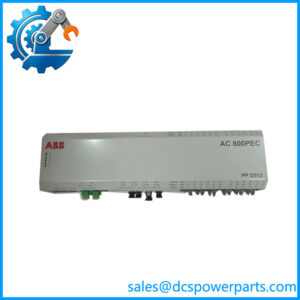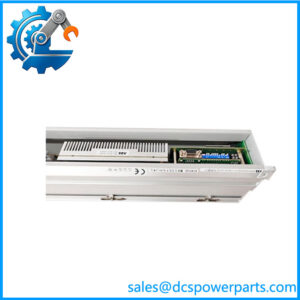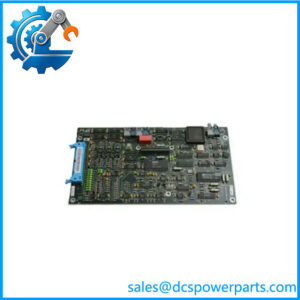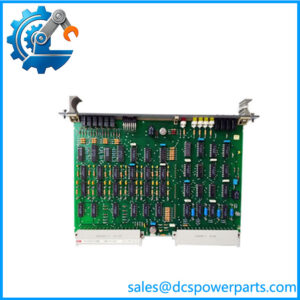
Description
ABB TPM810 Turbine Protection Module
Product Introduction
Turbine protection is not a conventional PLC I/O task: the protection module has to acquire the relevant field signals, condition them, and pass the information into a dedicated protection architecture. ABB TPM810 is the application-specific module used for this job in the ABB 800 Series TP800 Turbine Protection system. ABB specifies the TP800 architecture as CPM810 + TPM810 + TBU810, with additional ROM810v2, EIM810, or PCM810 modules used when the application requires them.
The TPM810 receives and conditions field I/O, converts relevant signals into digital outputs, and transfers digital information to the CPM810 Common Processor Module. This distinction matters when replacing a failed card: CPM810 handles the common processing function, while TPM810 provides the turbine-protection application interface. The pair should therefore be treated as part of the same engineered TP800 configuration rather than as interchangeable generic DCS modules.
Key Technical Specifications
| Parameter | Specification |
|---|---|
| Product Model | TPM810 |
| Manufacturer | ABB |
| Product Family | 800 Series Turbine Modules |
| Product Type | Turbine Protection Module |
| Application | TP800 Turbine Protection |
| Module Role | Application / field-interface module |
| Processor Partner | CPM810 Common Processor Module |
| Termination Base | TBU810 |
| System Communication | Profibus DP through TP800 architecture |
| Protection Functions | Overspeed trip; overspeed protection; trip anticipation; load-drop anticipation; power-load-unbalance |
| Mounting Architecture | One module slot in TBU810 |
| TBU810 Mounting | Standard 35 mm DIN rail |
| Field I/O Termination | TBU810 |
| System Supply Architecture | +24 VDC ±5% |
| Environmental Temperature | ABB 800 Series catalog documentation specifies 0 to 55°C for the equipment environment |
| System Certification | TP800 certified to IEC/EN 61508 SIL3 in the applicable certified configuration |
ABB’s current Symphony Plus catalog identifies the 800 Series as a Profibus DP-based turbine-control family and specifies modular mounting through the TBU810. The same documentation identifies as the application module and states that has IEC/EN 61508 SIL3 functional-safety certification. The SIL claim applies to the defined configuration, not to an isolated card.
Major Features / Advantages
Dedicated turbine-protection architecture
is purpose-built for turbine protection rather than being a general-purpose analog or digital I/O module. ABB’s documentation lists overspeed trip, overspeed protection including acceleration protection, trip anticipation, load-drop anticipation, and several power-load-unbalance functions. These functions are executed within the dedicated architecture rather than being treated as ordinary DCS logic.
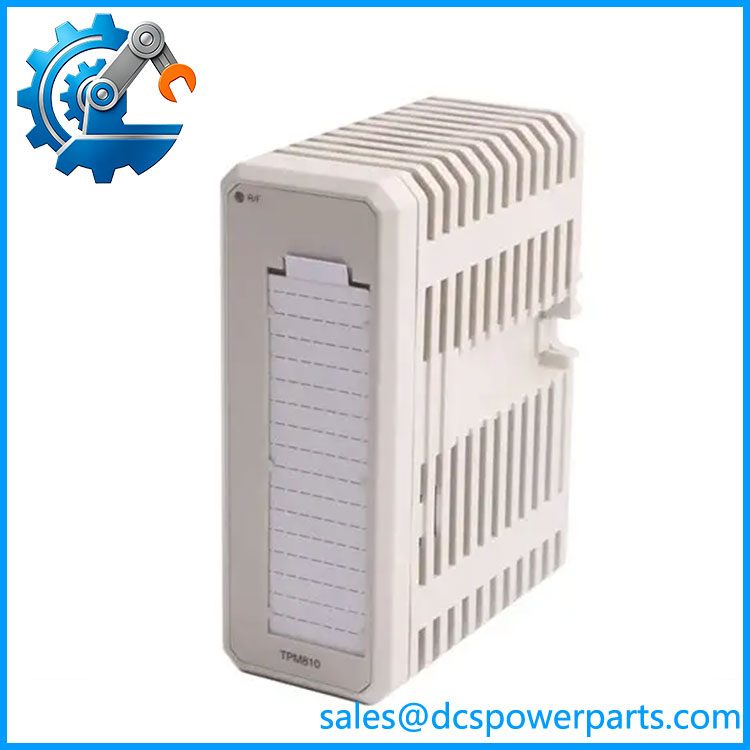
TPM810
Field signal conditioning before common processing
The receives and conditions field I/O, then transfers the resulting digital information to CPM810. That separation is important in troubleshooting. If the CPM810 is healthy but the protection system reports a field-channel problem, replacing the processor blindly may not address the fault. The and its associated termination/interface hardware need to be checked as well. ABB explicitly defines as the module that receives and conditions the field I/O for the application.
Works as part of a modular assembly
A functioning is not simply a inserted into a cabinet. ABB specifies one , one , and one as the basic hardware. ROM810v2 modules can provide additional relay outputs, EIM810 can expand I/O, and PCM810 can provide generator phase-current information where power-load-unbalance calculations require it.
Supports redundant protection architectures
A turbine protection installation may use several modules depending on the required redundancy architecture. ABB’s documentation gives a 2oo3 arrangement as an example requiring three modules. This is a system-level architecture decision, not a property that can be created simply by purchasing three loose cards.
Profibus-based integration
ABB describes the 800 Series as Profibus-based turbine modules that can be integrated with Symphony Plus, 800xA, or another Profibus-capable DCS. The architecture can also operate as a standalone solution using hardwired signals and PC-based configuration tools. This gives -based systems a defined interface path without making the protection logic dependent on ordinary DCS controller execution.
Revision control matters
ABB documentation records hardware revisions, including an earlier Rev. B and a Rev. 3.1 revision in the documented product evolution. That is a strong reason to record the actual hardware revision before ordering a replacement. A listing that says only “” does not establish that the physical revision is identical to the installed card.
Application Scenarios & Field Pain Points
Turbine overspeed protection
The uses as part of the protection architecture for overspeed trip and overspeed protection, including acceleration protection. These are protection functions where signal acquisition and response behavior are more important than simply matching the nominal module name.
Steam turbine protection
In steam-turbine installations, can form part of a configuration handling protective functions such as trip anticipation, load-drop anticipation, and valve-related protection logic. The exact field wiring and configured protection functions depend on the turbine application.
Gas and hydro turbine applications
ABB describes its 800 Series turbine modules as applicable to steam, gas, and hydro turbine control. The is specifically the protection application module within the product family.
Generator power-load-unbalance protection
Where power-load-unbalance calculations use generator phase-current signals, ABB specifies an optional PCM810. One PCM810 can interface to three modules in the documented architecture. This is a useful distinction during troubleshooting: a missing or faulty phase-current interface should not automatically be attributed to .
Related Products
- — Common Processor Module. Executes the defined application function and communicates with the control system through Profibus DP.
- — Termination Base Unit. Provides power, field connections, communications, and module connectors.
- ROM810v2 — Relay Output Module used to provide additional digital relay outputs from the .
- ROM830 — Voter module used with three ROM810v2 modules for 2oo3 relay-output voting.
- PCM810 — Phase Current Module for generator-current interfacing when required for power-load-unbalance calculations.
- EIM810 — Additional input/output expansion module for applicable configurations.
- SIM810 — Firmware upgrade module used with and in documented standalone configurations.
- — Complete turbine-protection architecture built around , , and .
Engineer’s Guide — Field Pitfalls to Avoid
1. Do not substitute for .
They perform different jobs. is the turbine-protection application module; is the common processor. ABB explicitly separates these functions.
2. Do not assume every revision is identical.
ABB’s published revision history identifies Rev. 3.1 as a later revision compared with Rev. B. Record the revision marking on the installed module before approving a spare.
3. Check the before replacing the module.
plugs into the . Damaged connectors, loose terminal wiring, contamination, or mechanical problems at the base can create symptoms that resemble a failed application module.
4. Do not confuse SIL certification with a standalone module rating.
ABB states that the modules have IEC/EN 61508 SIL3 certification in the applicable functional-safety configuration. That does not mean an isolated removed from the system carries an independent SIL3 claim.
5. Be careful with online reseller specifications.
Several current reseller pages describe as an 85–264 VAC Modbus RTU device. Those specifications conflict directly with ABB’s 800 Series documentation, which places inside the +24 VDC -based architecture and identifies Profibus DP at the system level. I would not use those reseller specifications for engineering or procurement decisions.
6. Verify the actual protection configuration.
The number of modules, ROM810 outputs, PCM810 interfaces, and voting arrangements depends on the turbine’s protection design. Matching the card number alone is not enough when the replacement affects a certified protection system.
FAQ
What is ABB ?
ABB is the Turbine Protection Module for the ABB 800 Series turbine-protection system. It receives and conditions field I/O, converts relevant signals into digital outputs, and transfers digital information to .
What is the difference between and ?
is the Common Processor Module, while is the application-specific turbine-protection module. ABB specifies the two together with to form the basic assembly. Replacing one with the other is not a valid functional substitution.
What functions does provide with ?
ABB identifies overspeed trip, overspeed protection including acceleration protection, trip anticipation, load-drop anticipation, and power-load-unbalance functions as part of the protection package.
Does use Modbus RTU?
ABB’s 800 Series documentation identifies Profibus DP as the system communication method. Several reseller pages incorrectly describe as a Modbus RTU device with an AC input. Those claims are not consistent with ABB’s documented architecture and should not be used as the basis for a replacement specification.
Does provide SIL3 protection by itself?
No. ABB documents SIL3 certification for the applicable turbine-protection configuration. The complete architecture, engineering, voting arrangement, firmware, wiring, and other safety requirements determine whether a deployed system meets the certified configuration.
What should I check before buying a replacement?
Confirm the exact model marking, hardware revision, installed revision/firmware, revision, field wiring arrangement, and redundancy architecture. For a safety-related replacement, photographs of the installed module and nameplate are more useful than a generic distributor listing.
Is a standalone I/O module?
Not in the conventional DCS sense. It is an application module within the architecture. The provides the physical termination, while supplies the common processing function. Additional modules such as ROM810v2, EIM810, and are used when the particular turbine application requires them.
Procurement Note
For a replacement, revision matching is more important than a generic “” label. ABB’s documented hardware history shows that revisions changed over the product’s life, while the module sits inside a safety-related turbine-protection architecture. Verify the actual inventory condition, hardware revision, and complete configuration before approving a spare. Do not rely on reseller specifications that conflict with ABB’s technical documentation.