Description
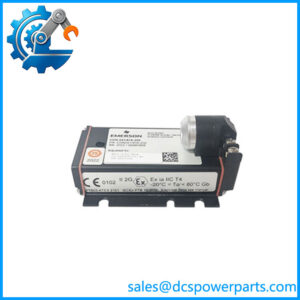
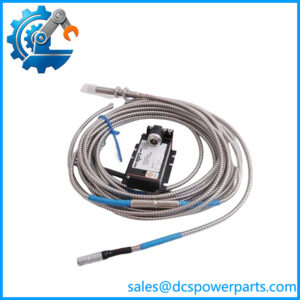
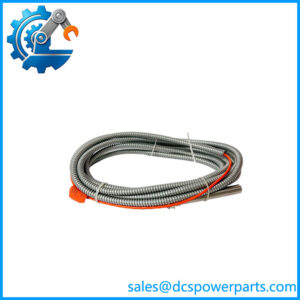
EPRO PR6423/002-041 Eddy Current Displacement Probe
Key Technical Specifications
| Parameter | Specification |
|---|---|
| Manufacturer | EPRO / Emerson |
| Model | PR6423/002-041 |
| Product Type | Eddy-current displacement probe |
| PR6423 Series | PR6423 |
| Probe Diameter | 8 mm |
| Measurement Principle | Non-contact eddy-current |
| Linear Measurement Range | 2 mm (80 mils) |
| Initial Air Gap | 0.5 mm (20 mils) |
| Incremental Scale Factor | Approx. 8 V/mm (203.2 mV/mil), configuration dependent |
| Case Configuration | 45 mm case |
| Adapter Plug | Included in this configuration |
| Cable Configuration | Approximately 10 m, open cable end according to available ordering records |
| Sensor Tip | PEEK |
| Probe Housing | Stainless steel |
| Cable Material | PTFE |
| Protection Class | IP66 |
| Sensor Operating Temperature | Approx. -35°C to +180°C |
| Typical Target | Ferromagnetic steel |
| Minimum Shaft Diameter | Approx. 25 mm |
| Installation | Threaded machine housing / bearing casing |
| Signal Conditioning | Requires compatible EPRO signal converter |
The 2 mm range, 0.5 mm initial gap, 8 mm probe format, stainless-steel housing, PEEK sensing tip, and high-temperature capability are consistent with published PR6423-series records.
Configuration note: Public records for the exact “-041” ordering code report a 45 mm case, adapter plug, and 10 m cable/open end. Other PR6423/002 variants are documented with different cable lengths and connector arrangements, so the exact suffix should be matched against the installed probe and machine documentation.
Product Introduction
The EPRO /002-041 is an 8 mm non-contact eddy-current probe intended for measurement of shaft movement in rotating machinery. Changes in the gap between the probe tip and conductive shaft target are converted by the associated signal-conditioning system into a proportional measurement signal. This makes the probe suitable for monitoring radial vibration, axial position, shaft eccentricity, and other displacement-related parameters.
The probe is part of the EPRO family commonly used in machinery protection and condition-monitoring systems. The probe itself is not a complete monitoring channel; it normally works with a compatible EPRO converter and monitoring system. Mechanical dimensions, cable configuration, converter type, target material, and installed calibration must all be considered when replacing one.
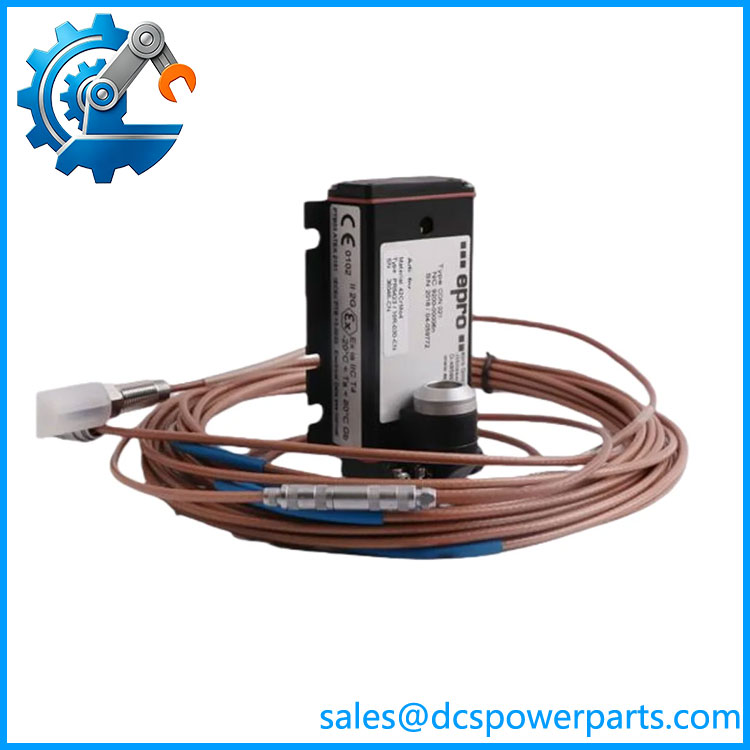
PR6423/10R-030-CN
Application Scenarios & Field Pitfalls — Engineer’s Perspective
The /002-041 is primarily a rotating-machinery measurement component, not a PLC or conventional analog input module. It is commonly encountered around turbines, compressors, pumps, gearboxes, and other machinery where shaft displacement or vibration needs to be measured without physical contact.
Common Applications
- Steam and gas turbines: Radial shaft vibration and position measurement.
- Compressors: Shaft displacement and eccentricity monitoring.
- Industrial pumps: Rotating-shaft vibration and mechanical condition monitoring.
- Machinery protection systems: Input sensing for EPRO/Emerson monitoring and protection equipment.
Field Pitfalls
1. The probe and converter form a calibrated measurement chain.
Do not replace the probe independently based only on diameter or measuring range. Probe characteristics, extension cable, converter, and calibration must correspond.
2. Initial gap is critical.
The published -series value is approximately 0.5 mm. The actual installation gap should be set according to the applicable EPRO installation procedure and the target shaft material. A mechanically secure probe can still produce an incorrect signal if the gap is wrong.
3. Target metallurgy affects measurement.
Published specifications use ferromagnetic steel such as 42CrMo4/AISI 4140 as the standard target. Do not assume identical calibration when the monitored shaft uses different metallurgy or surface treatment.
4. Do not confuse ordering-code variants.
/002-030 and /002-041 are both /002-family probes, but their connection/cable configurations can differ. The complete ordering code should be matched before procurement.
5. Cable condition is part of the measurement system.
Inspect the probe cable, connector/termination, shielding, routing, and mechanical protection during an outage. A damaged cable can produce an apparently unstable probe signal that is easily mistaken for an actual shaft-vibration problem.
Related Products
- — Same 8 mm probe family, but a different connection/cable configuration; not automatically interchangeable.
- — Related 8 mm configuration with different ordering-code details.
- — Related 8 mm eddy-current probe with a different mechanical/electrical configuration.
- — Related probe configuration for a different cable arrangement.
- — High-temperature -family probe configuration.
- CON021 — EPRO signal converter used with compatible probe configurations.
- CON041 — EPRO signal-converter family associated with measurement systems; exact probe/converter pairing must be verified.
- MMS 6410 — EPRO machinery monitoring hardware used in vibration/displacement monitoring systems.
- MMS 6000 Series — Related EPRO machinery monitoring platform family.
Procurement Note
For a replacement request, specify the complete code , not simply “ 8 mm probe.” Confirm the case configuration, cable length, cable termination, connector arrangement, converter model, shaft material, initial gap, and existing monitoring-system calibration.
Engineering recommendation: If the existing probe is being replaced because of an abnormal vibration reading, check the complete probe/converter loop before condemning the sensor. A damaged cable, incorrect gap, unsuitable target material, or mismatched converter can produce symptoms that look like probe failure.