Description
Key Technical Specifications
| Parameter | Specification |
|---|---|
| Product Model | 6410-009-N-N-N |
| Manufacturer | Pacific Scientific |
| Manufacturer Group | Danaher Motion |
| Product Series | 6410 |
| Product Type | Two-phase microstepping drive |
| Input Voltage | 24–75 VDC |
| Maximum RMS Phase Current | 5.0 A |
| Peak Phase Current | 7.1 A |
| Chopper Frequency | 20 kHz, reported in technical product listings |
| Maximum Step Frequency | 2.0 MHz, with input filter disabled |
| Step Resolution | Up to 51,200 steps/revolution reported for applicable configurations |
| Motor Type | Two-phase stepper motor |
| Command Method | Step and direction |
| Logic Signal Details | Verify against the original installation manual |
| Motor Connector | 5-position plug-in screw terminal |
| Mounting | Panel / equipment mounting |
| Heat Sink | Not included in the N-N-N configuration, according to secondary configuration descriptions |
| Protective Cover | Not included in the N-N-N configuration, according to secondary configuration descriptions |
| Operating Temperature | Verify against manufacturer documentation |
| Dimensions | Approximately 5 × 1.5 × 4.3 inches reported; confirm mechanical drawing |
| Protection Functions | Exact fault-monitoring behavior requires manual verification |
The 24–75 VDC supply range and 5 A RMS / 7.1 A peak current ratings are consistently reported. The step-frequency and resolution figures should be checked against the applicable 6410 installation manual and configuration settings before commissioning.
Product Introduction
Pacific Scientific 6410-009-N-N-N Microstepping Drive
The Pacific Scientific 6410-009-N-N-N is a 6410 Series microstepping drive designed to regulate the phase currents of two-phase stepper motors. It accepts a 24–75 VDC supply and supports up to 5 A RMS phase current, with a 7.1 A peak rating.
The drive is intended for automated positioning equipment requiring controlled incremental motion. Motor winding specifications, current settings, command timing, and cooling conditions must be checked before replacing an installed unit.
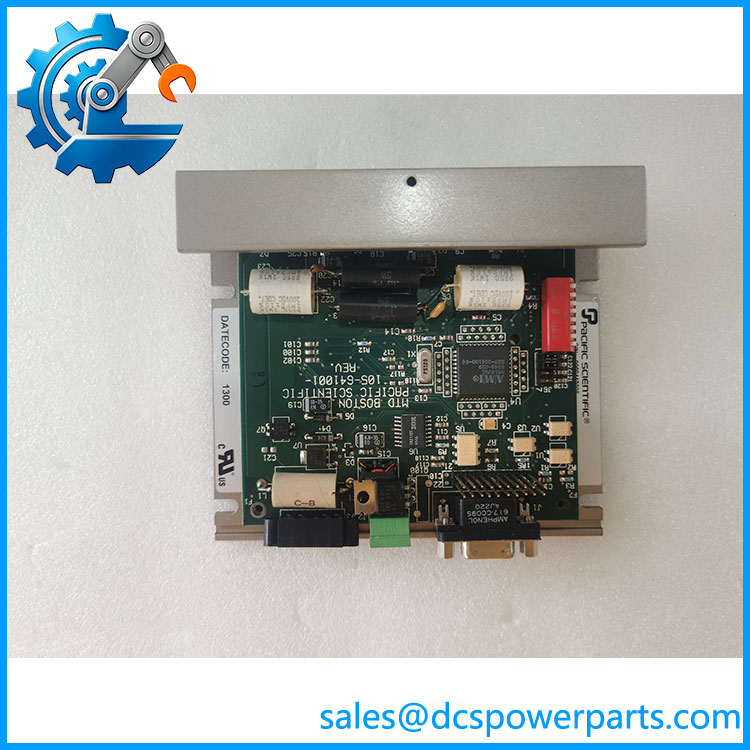
6410-009-N-N-N
Application Scenarios & Field Pitfalls (Engineer’s Perspective)
A stepper drive fault may appear as a mechanical positioning problem, but the cause can be an incorrect current setting, unstable DC supply, wiring error, or missing step commands. The 6410-009-N-N-N should be evaluated as part of the complete motor-control system.
Typical application scenarios
- Precision indexing equipment: Controls incremental movement in automated positioning and indexing mechanisms.
- Packaging machinery: Drives stepper motors used for material feeding, positioning, and synchronized movement.
- Inspection and dispensing equipment: Supports repeatable positioning in automated inspection and dispensing mechanisms.
- OEM motion-control systems: Serves as a replacement drive in equipment originally designed around the Pacific Scientific 6410 Series.
Field pitfalls to check before replacement
1. Motor phase wiring: Identify both motor winding pairs before connecting the drive. Incorrect phase pairing can cause vibration, poor torque, or failure to rotate. Do not rely solely on wire colors from an old installation.
2. Current configuration and motor rating: The 5 A RMS maximum is a drive capability, not an instruction to operate every motor at 5 A. Set the phase current according to the motor’s rated current and the original machine configuration. Excessive current can cause motor overheating and shorten winding life.
3. DC supply and command signals: Confirm that the DC bus remains within 24–75 VDC during acceleration and deceleration. Check step and direction signal levels, pulse timing, grounding, and cable shielding. Noise on the command lines can produce missed steps or inconsistent positioning.
Related Products
| Model | Product Description | Relationship |
|---|---|---|
| 6410-001-N-N-N | 6410 Series stepper drive | Same product family; verify current rating and configuration |
| 6410-007-N-N-N | 6410 Series stepper motor driver | Related drive variant |
| 6410-020-N-N-N | 6410 Series stepper drive | Related model |
| 6410-024-N-N-N | 6410 Series stepper drive | Related model with the same reported 5 A RMS / 7.1 A peak class |
| 6410-031-N-N-N | Stepper-drive PC board assembly | Related hardware reference; not confirmed as a complete substitute |
| 6415-009-N-N-N | 6415 Series stepper drive | Related drive family with different control configuration |
| 6435-001-N-N | Step driver | Related Pacific Scientific motion-control product |
| 6440-001-K-N | Microstepping drive with indexer | Different drive architecture |
These are related Pacific Scientific drive-family references. Their electrical ratings, command interfaces, and mechanical configurations are not necessarily interchangeable.
Procurement and Quality Control Notes
Before purchasing a replacement 6410-009-N-N-N, verify:
- Complete model number, including all three suffix positions.
- Input voltage and DC supply polarity.
- Motor phase resistance and rated phase current.
- Current-setting switch positions or configuration settings.
- Step and direction input operation.
- Motor output terminal condition.
- Signs of overheating, damaged components, or cracked connectors.
- Functional testing with a compatible two-phase stepper motor.
Important configuration warning: The N-N-N suffix is part of the complete ordering designation. Do not substitute a model with a different suffix based only on its 6410 Series designation. Verify the cover, heat-sink, connector, and customization options against the original unit.
For incoming inspection, a power-on check is insufficient. Request a documented test of both motor phases, command response, current regulation, and operation under an appropriate motor load.