Description
Key Technical Specifications
| Parameter | Specification |
|---|---|
| Product model | MVME2301 |
| Manufacturer | Motorola Computer Group |
| Processor | MPC603 PowerPC |
| Processor frequency | 200 MHz |
| DRAM | 16 MB ECC-protected |
| Flash memory | 1 MB socketed + 4 MB surface-mounted |
| NVRAM | 8 KB with real-time clock and battery backup |
| Form factor | 6U VMEbus |
| PMC expansion | 2 IEEE P1386.1 slots |
| PMC bus clock | 33 MHz |
| Ethernet | DEC 21140, 10/100Base-T |
| Serial interface | PC16550 asynchronous debug port |
| VMEbus interface | VME64, P1/P2 connectors |
| Backplane supply | +5V, +12V, -12V |
| +5V consumption | 4A typical, 4.75A maximum |
| Operating temperature | 0 to +55°C, forced-air cooling |
| Storage temperature | -40 to +85°C |
| Relative humidity | 10–80% |
| Dimensions | 233 × 19.8 × 160 mm (board/front-panel reference dimensions) |
Specifications are taken from the Motorola MVME2300-Series Installation and Use manual.
Product Introduction
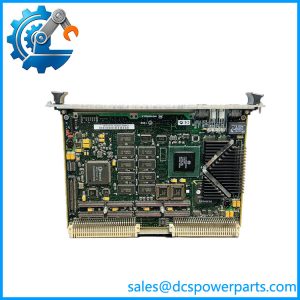
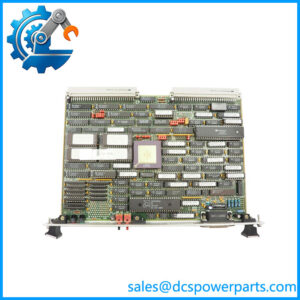
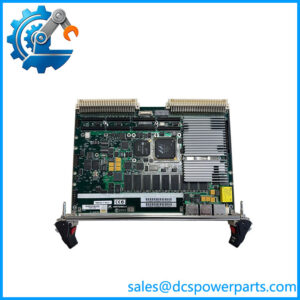
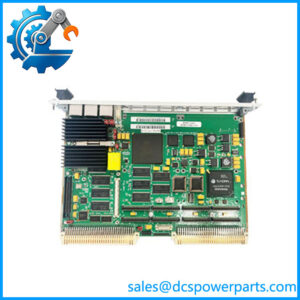
The Motorola MVME2301 is an embedded VME processor module intended for computer-based industrial control, data acquisition, and specialized equipment applications. Its MPC603 PowerPC processor operates at 200 MHz and works with 16 MB of ECC-protected DRAM. The board also includes Flash memory, battery-backed NVRAM, a real-time clock, and programmable timers.
Its dual PMC architecture supports application-specific expansion cards, including front-panel and rear P2 I/O configurations. The board connects to the VMEbus through P1 and P2 backplane connectors and provides 10/100Base-T Ethernet and a serial debug interface. This makes the MVME2301 a processor and expansion platform rather than a conventional PLC I/O module.
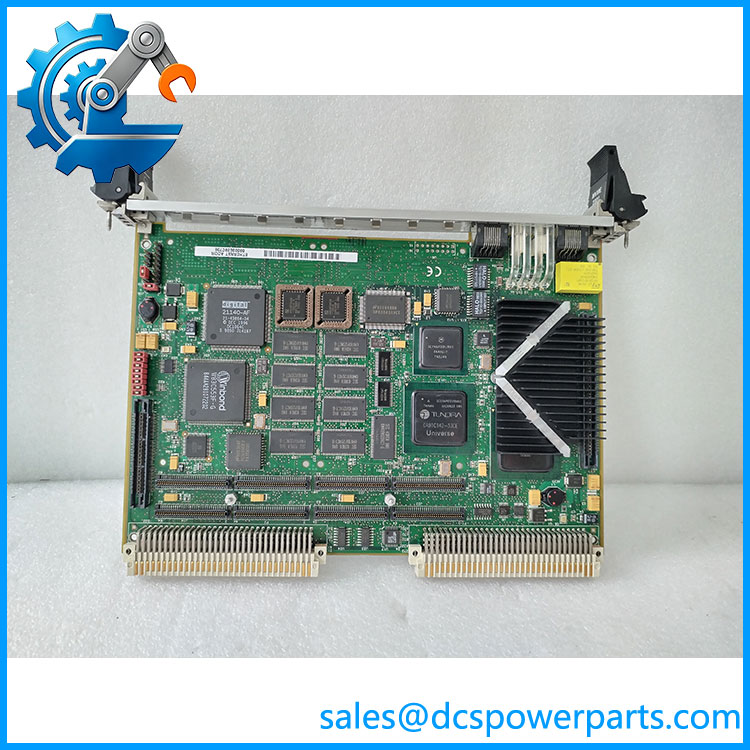
MVME2301
Major Features and Advantages
PowerPC embedded processing
The 200 MHz MPC603 processor provides the main computing resources for embedded applications. Its architecture is distinct from the MPC604-based MVME2305 family, so processor equivalence should not be assumed.
ECC-protected memory
The 16 MB DRAM configuration includes error-correcting code protection. This supports memory-error detection and correction during operation.
Dual PMC expansion
Two PMC slots support compatible single-width or double-width expansion cards. Optional PMCspan modules can extend the architecture to as many as six PMC positions, subject to the required carrier configuration.
VMEbus integration
The board communicates through the VMEbus P1 and P2 connectors. Its VME interface supports master and slave operations, making it suitable for integration into compatible VME computer systems.
Ethernet and serial diagnostics
The onboard Ethernet controller supports 10/100Base-T networking. The serial debug interface provides access to PPCBug firmware for startup diagnostics and board configuration.
Nonvolatile system resources
Battery-backed NVRAM and the real-time clock retain important system information. Battery condition is an important inspection point when evaluating older boards.
Application Scenarios and Field Pitfalls
Potential applications include:
- Legacy VME industrial control computers.
- Semiconductor manufacturing equipment.
- Automated test and measurement systems.
- Industrial data acquisition platforms.
- Embedded machine-control systems.
- Custom VME-based processing equipment.
Important installation checks:
- Verify the exact MVME2301 model rather than an MVME2305 or another family variant.
- Confirm P1 and P2 backplane connector compatibility.
- Check the VMEbus system-controller jumper configuration.
- Verify the installed PMC cards and their P2 pin assignments.
- Inspect the battery-backed NVRAM and real-time clock.
- Confirm the PPCBug firmware and application software configuration.
- Provide forced-air cooling within the specified operating temperature range.
One common procurement mistake is treating all MVME2300 boards as equivalent. The MVME2301 uses the MPC603 at 200 MHz with 16 MB DRAM, while the MVME2305 uses the MPC604 at 300 MHz. Their configurations are not interchangeable by model-family designation alone.
Related Products and Variants
| Model | Processor | ECC DRAM |
|---|---|---|
| MVME2301 | MPC603, 200 MHz | 16 MB |
| MVME2302 | Configuration-dependent | 32 MB |
| MVME2303 | Configuration-dependent | 64 MB |
| MVME2304 | Configuration-dependent | 128 MB |
| MVME2305 | MPC604, 300 MHz | 16 MB |
| MVME2306 | Configuration-dependent | 32 MB |
| MVME2307 | Configuration-dependent | 64 MB |
| MVME2308 | Configuration-dependent | 128 MB |
The optional PMCspan-002 and PMCspan-010 are expansion accessories, not replacement processor boards.
Procurement and Quality Control
For replacement procurement, request photographs showing the complete model label, PCB assembly number, processor marking, memory configuration, and front-panel connectors.
Recommended inspection and testing:
- Visual inspection for corrosion, damaged components, and PCB contamination.
- Battery and NVRAM condition check.
- PPCBug startup and diagnostic test.
- DRAM and Flash memory verification.
- Ethernet and serial-port communication tests.
- VMEbus backplane communication test.
- PMC slot functionality test where expansion cards are required.
Procurement recommendation: Specify Motorola , MPC603 200 MHz, 16 MB ECC DRAM. Confirm the board assembly revision and installed firmware before accepting a replacement.