Description
Product Introduction
When a legacy control or test system depends on a VME-based computer, replacing the processor board can involve more than matching the physical form factor. BIOS settings, boot media, operating-system support, PMC expansion hardware, and application software may all affect recovery.
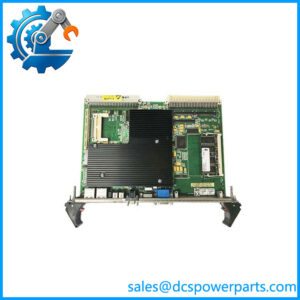
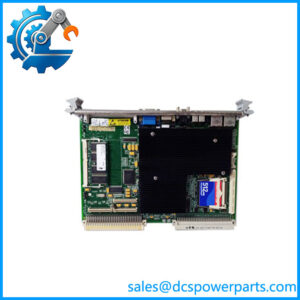
The GE Fanuc V7768-320000 combines a VMEbus interface with x86 processing and multiple peripheral connections. For maintenance and procurement teams, the key is to match the installed processor variant, memory, firmware, and rear-I/O arrangement before selecting a replacement board.
Key Technical Specifications
| Parameter | Specification |
|---|---|
| Model | V7768-320000 |
| Manufacturer | GE Fanuc Intelligent Platforms |
| Product family | V7768 |
| Product type | 6U VMEbus single-board computer |
| Processor | Intel Core 2 Duo up to 2.16 GHz; optional Celeron M configuration |
| Chipset | Intel 945GME Express for the documented Core 2 Duo configuration |
| Memory | Up to 2 GB DDR2 SDRAM through one SODIMM slot |
| System bus | Up to 667 MHz for the Core 2 Duo configuration |
| Storage | Two SATA interfaces; CompactFlash boot support is also documented |
| Network | Dual Gigabit Ethernet |
| USB | Four USB 2.0 ports in documented configurations |
| Serial interfaces | Two serial ports, subject to the board’s I/O configuration |
| Expansion | One PCI-X-capable PMC site |
| VME interface | VMEbus; confirm the precise compliance level against the hardware manual |
| Board power | +5 VDC primary rail; verify auxiliary supply requirements |
| Operating temperature | 0°C to +55°C for the Core 2 Duo version; up to +70°C for the documented Celeron M option |
| Operating system | Depends on the installed configuration and software image; legacy systems may use Linux or VxWorks |
| Installation | VME chassis; confirm slot, cooling, and rear-I/O requirements |
These specifications are based on available V7768 product descriptions. Exact port placement, processor, boot-media support, and temperature rating should be checked against the hardware revision and original technical manual.
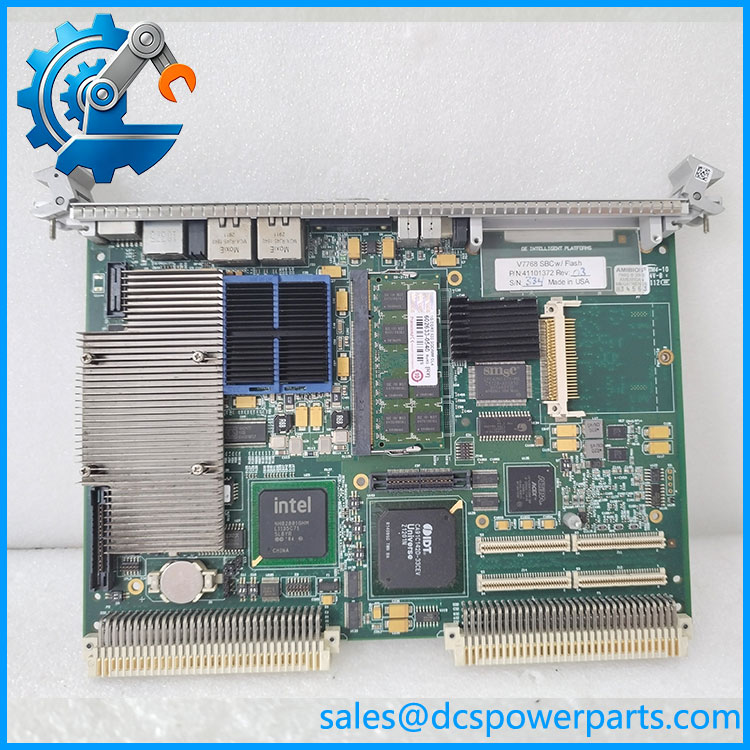
V7768-320000
Application Scenarios & Pain Points
A VME computer failure can stop an entire legacy control or data-acquisition system even when the I/O boards remain functional. The V7768-320000 may be relevant to the following installations when the original system was designed for this platform.
- Industrial control systems: Embedded processing in established VME-based automation equipment.
- Power-generation equipment: Computing and data processing within legacy turbine-control or plant-support systems, where specified by the equipment design.
- Test and measurement systems: Host processing for data acquisition, test sequences, and instrument interfaces.
- Embedded simulation and monitoring: Processing tasks that depend on VME expansion boards and application-specific software.
Field troubleshooting note: Before swapping the board, check the power rails, boot-media condition, BIOS settings, cooling, and VME backplane connections. A failed boot may originate in the storage device or operating-system image rather than the CPU board itself.
Related Products
These models are useful for technical comparison, but they are not confirmed direct replacements for the V7768-320000.
- VMIVME-7750 — Older VMEbus single-board computer with a different processor generation and platform requirements.
- VMIVME-5565 — Reflective-memory hardware used for high-speed data exchange; not a CPU-board substitute.
- -32001 — A related model designation reported in supplier catalogs; verify the exact configuration and part-number mapping before comparing specifications.
- PMC237CM1/V — PMC expansion hardware associated with additional PMC-site functionality; confirm the required carrier and mechanical configuration.
- GE VMEbus PMC modules — Expansion cards may provide specialized interfaces or processing, but compatibility depends on the ‘s PMC support and the installed software.
Engineer’s Guide: Replacement Checks
1. Match the processor and board configuration.
Warning: The Core 2 Duo and Celeron M versions have different performance and temperature characteristics. Confirm the installed CPU, memory, board revision, and part-number suffix.
2. Preserve boot and application dependencies.
Record BIOS settings, CompactFlash or other boot-media contents, operating-system version, application licenses, and any custom device drivers. A replacement board may power up correctly but still fail to run the original application.
3. Verify chassis and I/O compatibility.
Check the VME backplane, rear-I/O connections, PMC expansion card, power rails, and cooling arrangement. Do not assume that every 6U VME board has identical pin assignments or software support.
For refurbished hardware, request actual-board photographs, the CPU and memory configuration, a successful boot-test report, and confirmation of included accessories. If the board is part of a production-critical system, validate the replacement in a controlled test environment before returning it to service.
Frequently Asked Questions
Q1. What is the GE Fanuc -320000 used for?
It is a VMEbus single-board computer for embedded computing, industrial control, and data-acquisition systems that were designed around this platform.
Q2. Does the -320000 use an Intel Core 2 Duo processor?
The documented configuration supports an Intel Core 2 Duo processor up to 2.16 GHz. An Intel Celeron M variant is also reported. Confirm the actual CPU on the supplied board.
Q3. How much memoes the support?
Available product documentation specifies up to 2 GB of DDR2 SDRAM through a single SODIMM slot. Confirm memory type and capacity before purchasing a replacement.
Is the compatible with every VME chassis?
No. Mechanical fit is only one requirement. Verify the backplane, VME interface, power rails, rear-I/O arrangement, cooling, and any PMC expansion hardware.
Q5. What operating systems can it run?
Supplier documentation references Linux and VxWorks, among other legacy operating-system configurations. Actual support depends on the board revision, BIOS, device drivers, and the software image used by the original equipment.
Q6. Can I replace it with a VMIVME-7750?
Not as a direct substitution without an engineering review. The VMIVME-7750 belongs to a different hardware generation and may have different processor, memory, interface, and software requirements.
Q7. What should I confirm before ordering a replacement?
Verify the full part number, processor variant, memory, board revision, boot media, PMC card, rear-I/O configuration, test results, warranty, and delivery estimate. For a legacy system, matching the original configuration is generally safer than selecting a board based only on its VME form factor.