Description
Product Overview
The GE PCIE-5565PIORC-100A00 is a reflective memory interface card designed for real-time systems that need fast, deterministic data sharing between multiple computers or embedded control nodes. Rather than routing every exchange through conventional network software, reflective memory hardware propagates writes across the fiber-optic network so that corresponding memory locations are updated at connected nodes. This architecture is useful in distributed control, simulation, test systems, and other applications where multiple processors need access to synchronized data with limited host-CPU involvement.
The GE PCIE-5565PIORC-100A00 belongs to the 5565 family and uses a PCI Express host interface. Published documentation describes a 2.12 Gbaud fiber link, support for as many as 256 nodes, and data transfer rates ranging from approximately 43 MB/s to 170 MB/s in nonredundant operation, depending on packet size. The product family also supports redundant network operation, network interrupts, DMA, and configurable data handling for systems with different processor architectures. Memory capacity is configuration-dependent, so buyers should not assume that every card has the same installed SDRAM capacity.
For replacement planning, the GE PCIE-5565PIORC-100A00 must match the host computer’s PCIe slot, required optical interface, memory configuration, driver package, and network topology. Node ID switches are particularly important when network interrupts are used: each participating card needs a unique node ID. Check the existing card’s part number and revision, fiber connectors, cable type, and software environment before removing a working unit. A card that fits mechanically may still fail to communicate if its configuration or driver stack differs from the installed system.
Product Introduction
The PCIE-5565PIORC-100A00 provides a fiber-optic reflective memory connection for distributed real-time computing systems. Its hardware-managed data propagation supports shared data access across connected nodes without requiring the host processor to manage every network transfer.
Before installation, verify the PCIe slot, memory capacity, optical interface, node ID settings, and operating-system driver. The documented cooling requirement is 300 linear feet per minute (LFM), which should be considered when checking airflow in an embedded or industrial computer enclosure.
Key Technical Specifications
| Parameter | Specification |
|---|---|
| Manufacturer | GE Intelligent Platforms / Abaco Systems |
| Full model | PCIE-5565PIORC-100A00 |
| Product type | PCI Express reflective memory node card |
| Host interface | PCI Express, four lanes |
| PCIe signaling rate | 2.5 Gbit/s per lane |
| Fiber serial link | 2.12 Gbaud |
| Memory capacity | 128 MB or 256 MB, depending on configuration |
| Network size | Up to 256 nodes |
| Nonredundant transfer rate | 43–170 MB/s, depending on packet size |
| Redundant transfer rate | 20–87 MB/s, depending on packet size |
| Network topology | Ring or star, depending on system configuration |
| Fiber type | Multimode or single-mode options within the product family; verify the exact card |
| Maximum fiber distance | Depends on fiber type and cable configuration; published family documentation lists up to 300 m multimode and 10 km single-mode |
| Network interrupts | Four general-purpose network interrupts are documented |
| DMA | Independent DMA channel |
| Operating systems | Linux, Windows, and VxWorks; verify driver and version compatibility |
| Cooling requirement | 300 LFM |
| Dimensions | Approximately 6.6 × 2.713 inches |
| Weight | Approximately 0.2 lb |
| Condition | Not specified; verify with supplier |
Specifications are drawn from product-family documentation. Confirm the exact installed memory, optical interface, and hardware revision against the individual card and its applicable datasheet.
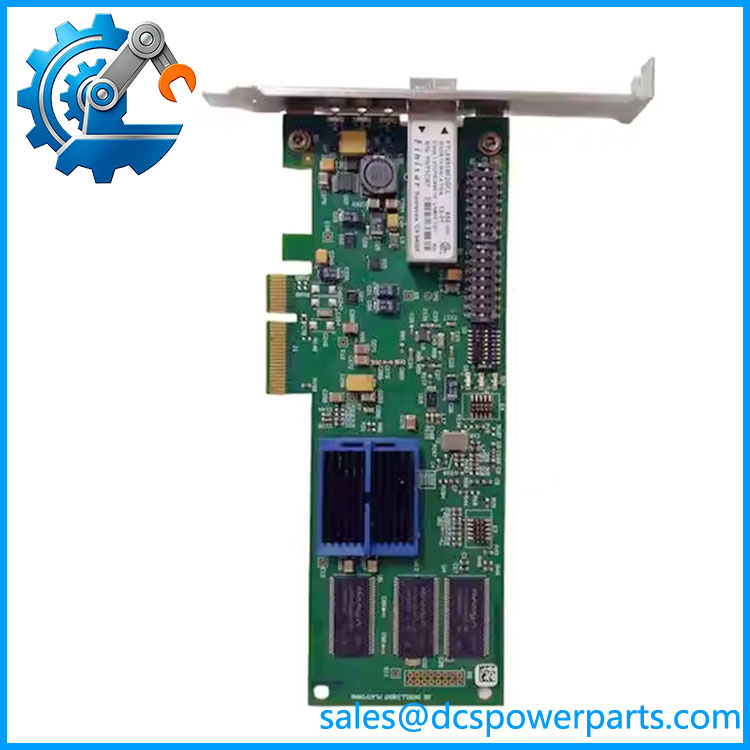
PCIE-5565PIORC-100A00
Related Products
The following products are related by function or reflective memory architecture. They are not all direct replacements.
- PCIE-5565PIORC — Base model designation for the PCI Express reflective memory card family.
- PMC-5565PIORC — PMC-format reflective memory card; requires the appropriate host carrier or compatible system.
- PCI-5565PIORC — Legacy PCI reflective memory card; uses a different host bus interface.
- cPCI-5565PIORC — CompactPCI variant for compatible industrial or test-system chassis.
- RFM2g — Reflective memory product family with its own hardware and driver requirements.
- 2BARCBD1 — Abaco PCI/PMC carrier reference associated with certain legacy PCI reflective memory replacement arrangements; verify the intended card pairing.
- NI PXI/PXIe systems — Potential host platforms for compatible reflective memory configurations, subject to chassis, adapter, and driver support.
- GE/Abaco 5565 fiber-optic cables — Optical interconnects must match the installed card’s fiber type, connector, and link arrangement.
Frequently Asked Questions
Q1. Can the PCIE-5565PIORC-100A00 replace an older reflective memory card directly?
Not automatically. Confirm the host bus, memory configuration, optical interface, node configuration, and driver compatibility. A PCI, CompactPCI, PMC, or PCIe card may require a different carrier or host platform.
Q2. Can I hot-swap this card?
Do not assume hot-swap support. Power down the host system and follow the computer manufacturer’s installation procedures unless the complete platform explicitly supports hot-plug operation.
Q3. Does this card require firmware or driver configuration?
Driver support is important. Abaco publishes software resources for the 5565 family, but compatibility depends on the operating system, driver version, and application environment. Record the current driver and software configuration before replacing the card.
Q4. How do I configure the node ID?
The hardware reference manual describes onboard switches for node identification. When network interrupts are used, each card on the reflective memory network must have a unique node ID. Document the existing switch positions and verify the network configuration before startup.
Q5. Is the card suitable for deterministic real-time applications?
That is its intended application. Reflective memory distributes data through hardware-managed fiber links, reducing host-processor involvement in network transfers. Actual system timing still depends on topology, traffic, packet size, redundancy settings, and application design.
Q6. How can I verify the exact memory and optical configuration?
Check the complete ordering code, board labels, revision markings, installed memory specification, and optical connectors. Do not rely on the base model alone because the product family includes multiple memory and fiber configurations.
Q7. What should I request when purchasing a replacement?
Ask for clear photographs of the actual board and its labels, confirmation of the full part number and revision, installed memory capacity, optical interface details, and a functional test report. Confirm whether the unit is new surplus, refurbished, or previously used, and obtain written warranty and return terms.