Description
Key Technical Specifications
| Parameter | Value |
|---|---|
| Model | DS3800DFXA1B1C |
| Manufacturer | General Electric |
| Product Family | Mark V / Speedtronic |
| Board Function | Analog I/O and signal conditioning |
| Associated Function | TCQA |
| LVDT | Supported |
| Thermocouple | Supported |
| Current Inputs | 0–1 mA and 4–20 mA |
| Current Outputs | 4–20 mA |
| Pulse Inputs | Supported |
| Connector Interfaces | JA, JB, JD, JE, JG, 3PL |
| Configuration | Hardware jumpers and Mark V I/O configuration |
| Application | Gas/steam turbine control |
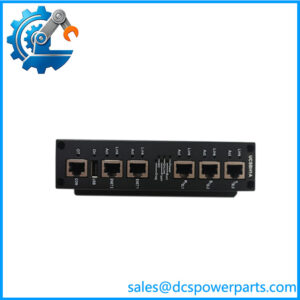
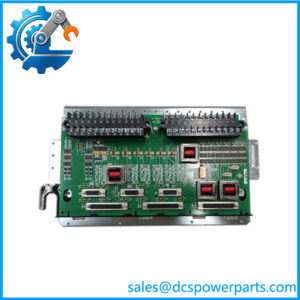
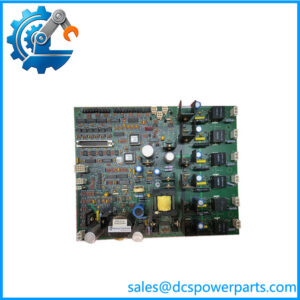
Available technical documentation identifies the DS3800DFXA1B1C as an analog I/O board associated with the TCQA function in GE Mark V turbine control. It conditions signals including LVDT, thermocouple, current, vibration, pulse, voltage, and generator/line-related signals.
Important identification note: Some third-party listings incorrectly associate this part number with Mark VIe, ControlLogix, or generic processor functions. Those claims conflict with the more specific Mark V/TCQA technical description. For procurement and engineering purposes, verify the board silkscreen, connector arrangement, and installed Mark V rack documentation before substitution.
Product Introduction
What the DS3800DFXA1B1C Does
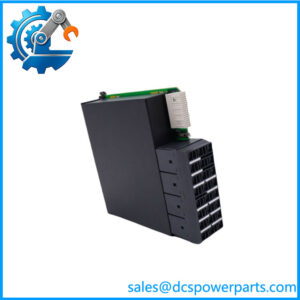
The GE DS3800DFXA1B1C is an analog I/O and signal-conditioning board used in the GE Mark V turbine control architecture. Its circuitry scales and conditions field signals before they are processed by the Mark V control system, including LVDT position, thermocouple, 4–20 mA, pulse-rate, vibration, and related turbine signals.
Its importance is architectural. This is not simply an analog input card that can be replaced by any modern AI module. The board interfaces with specific Mark V terminal and core hardware through defined connectors such as JA, JB, JD, JE, JG, and 3PL. Hardware jumpers and software configuration both affect signal behavior.
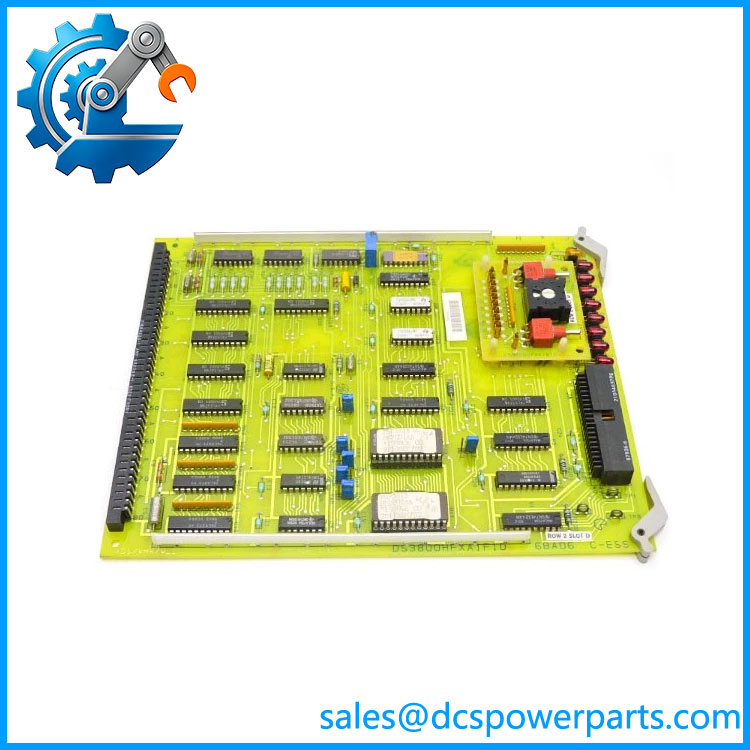
DS3800DFXA1B1C
Application Scenarios & Field Pitfalls
Engineering Pain Point
When a legacy turbine begins showing unstable temperature, position, current, or speed-related values, engineers often start by replacing the field transmitter. That can be the wrong place to start. In a Mark V system, the signal path includes the terminal board, ribbon connection, analog conditioning circuitry, I/O processing, and configuration constants. A problem anywhere along that chain can produce a believable but incorrect engineering value.
Typical Applications
- Gas Turbines — LVDT feedback, fuel-related analog signals, thermocouple inputs, and control-device outputs.
- Steam Turbines — Temperature, position, vibration, and auxiliary analog signal conditioning.
- Power Generation — Mark V turbine control cores requiring legacy analog I/O processing.
- Turbine Maintenance Systems — Replacement of failed or degraded Mark V analog I/O hardware.
Technical Pitfalls to Avoid
- Do not confuse the board with the complete TCQA assembly.
The available technical reference describes the DS3800DFXA1B1C as a board associated with the TCQA function, while the larger Mark V architecture can contain related DS200/DS215 hardware. Confirm the exact board level and assembly designation before ordering. - Check the hardware jumper configuration.
The documented TCQA configuration uses jumpers including J1/J2 for the mA output circuit and J5/J6 for output-current range selection. A replacement board with different jumper settings can produce incorrect signal behavior even when the hardware itself is functional. - Check the signal source before replacing the board.
For 4–20 mA circuits, inspect the terminal board, field wiring, loop resistance, and transmitter first. For thermocouples, verify cold-junction reference and wiring polarity. For LVDT circuits, inspect excitation and feedback wiring. - Record ribbon-cable positions before removal.
The board uses multiple identified connectors. The installation reference specifically advises identifying the connector locations before removing ribbon cables. This is a small step that prevents an unnecessarily difficult restart. - Do not apply modern Mark VIe specifications to this board.
The DS3800 family belongs to a much older GE turbine-control architecture. Several current online listings misclassify this exact part number. Treat unsupported claims about Ethernet, modern fieldbus protocols, hot swapping, or Mark VIe compatibility with caution.
Related Products
- DS215TCQAG1 — Related Mark V analog I/O board assembly associated with the TCQA function. It is important when determining whether the requirement is for the DS3800 daughter/associated board or the larger DS215 assembly.
- DS200TCQAG1 — Mark V analog I/O hardware referenced in technical descriptions of the TCQA architecture. It should not be assumed to be a direct replacement for the DS3800DFXA1B1C without checking the complete assembly and revision.
- DS200TCQBG1BCB — Mark V analog I/O expansion hardware. Its role is related to analog signal processing, but its hardware configuration and connector arrangement differ from the .
- DS200TCPSG1A — Mark V power-supply module. It supports the control-system power architecture rather than performing analog signal conditioning, so it is complementary rather than a functional substitute.
- DS200TCPAG1AJD — Mark V turbine control processor board. It performs control-processing functions while the handles signal-conditioning/I/O functions. These boards operate at different levels of the control architecture.
- DS200TCCAG1BAA — Mark V signal-processing board. It is relevant when troubleshooting the broader signal-processing chain, but it should not be treated as an equivalent analog I/O replacement.
- DS200TCEAG1 Series — Mark V emergency overspeed boards. These serve turbine overspeed protection rather than general analog I/O, making them complementary safety/control hardware rather than alternatives.
- DS200TCRAG1 Series — Mark V relay output hardware. It handles relay-based control outputs and therefore differs substantially from the analog signal-conditioning role of the .
Procurement note: For this obsolete GE board, specify the complete number and provide a photograph of the board label when possible. The distinction between the DS3800 board, associated TCQA hardware, and later DS200/DS215 assemblies matters. Do not approve a replacement based solely on the phrase “GE Mark V analog I/O board.”