Description
Key Technical Specifications
| Parameter | Value |
|---|---|
| Manufacturer | Absolute Process Instruments |
| Model | API 4380G |
| Product Type | DC Signal Conditioner / Isolated Transmitter |
| Signal Type | Analog DC voltage and current |
| Input Voltage Range | 0–50 mVDC to 0–10 VDC |
| Bipolar Input Range | ±50 mVDC to ±10 VDC |
| Input Current Range | 0–1 mADC to 0–20 mADC |
| Output Voltage Range | 0–1 VDC to ±10 VDC |
| Output Current Range | 0–2 mA to 0–20 mA / 4–20 mA |
| Isolation Voltage | 2000 Vrms minimum |
| Isolation Type | Input / Output / Power three-way isolation |
| Input Impedance | 1 MΩ minimum (voltage input) |
| Current Input Burden | Approx. 1 VDC at 20 mA |
| Loop Power Supply | 18 VDC unregulated, 25 mA maximum |
| Response Time | Approx. 100 ms typical |
| Fast Response Option | DF option available |
| Mounting | API-008 8-pin socket |
| Installation | DIN rail or panel mounting |
| Power Supply | 115 VAC standard; optional 9–30 VDC or universal AC/DC versions |
| Indicators | Input and output LoopTracker LEDs |
| Test Function | Adjustable output test button |
| Protection | Full signal isolation and noise rejection |
Product Introduction
Absolute Process Instruments API 4380G Overview
The Absolute Process Instruments API 4380G is a field-configurable DC signal conditioner designed for industrial automation applications where analog signals require conversion, isolation, scaling, or retransmission. It provides an interface between field instrumentation and control systems such as PLCs, DCS platforms, SCADA systems, recorders, and data acquisition equipment.
The API 4380G accepts a wide range of DC voltage and current signals, allowing one module to support multiple process signal requirements. Input ranges include low-level millivolt signals, standard voltage signals, and current loop signals. The output can be configured for commonly used industrial analog standards, reducing the need for multiple dedicated signal conversion modules.
The API 4380G uses optical isolation between input and output circuits, combined with isolated power design, creating complete three-way isolation between field signals, output circuits, and module power. This design helps reduce ground loop problems, common-mode interference, and electrical noise issues often found in industrial measurement environments.
The API4380G includes LoopTracker LED indicators that provide a visual indication of input and output signal activity. During commissioning and troubleshooting, technicians can quickly verify whether an analog loop is receiving and transmitting expected signals without immediately requiring additional measurement equipment.
The API 4380G is commonly installed in process control panels, instrumentation cabinets, and industrial interface systems. It is not a controller module; its role is signal conditioning between field devices and automation equipment.
When replacing an API 4380G, engineers should verify the selected input/output ranges, power supply version, socket type, wiring arrangement, and loop requirements. The module configuration directly affects signal scaling, so matching the hardware alone is not sufficient.
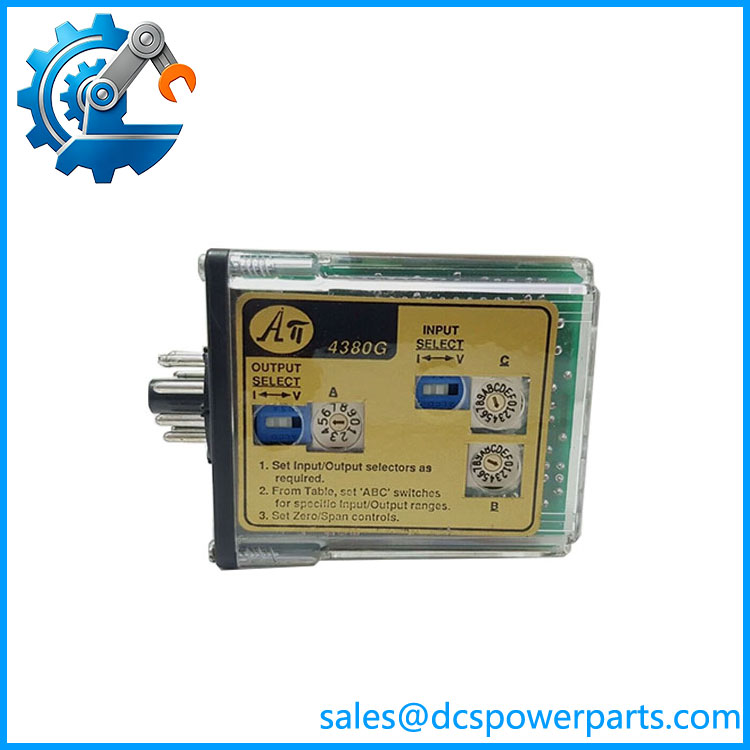
API4380G
Application Scenarios & Field Considerations
Engineering Pain Point
An analog signal appears unstable, incorrectly scaled, or unavailable at the PLC/DCS input. The signal conditioner may be suspected, but the actual issue may involve transmitter calibration, wiring, grounding, or incorrect range selection.
Recommended troubleshooting steps:
- Verify input signal level
- Confirm API switch configuration
- Measure output current or voltage
- Check loop power availability
- Inspect shield grounding
- Verify PLC/DCS analog channel scaling
The API 4380G conditions the signal, but the complete instrumentation loop determines measurement accuracy.
Typical Applications
Process Instrumentation
Used for:
- Pressure transmitter interfaces
- Flow measurement signals
- Temperature transmitter conversion
- Level monitoring systems
PLC and DCS Integration
Applied for:
- Analog input compatibility
- Signal standard conversion
- Electrical isolation between systems
Industrial Test Systems
Used for:
- Data acquisition interfaces
- Measurement equipment integration
- Laboratory automation systems
Control Panel Applications
Applied for:
- Panel meters
- Recorders
- Signal distribution systems
Technical Pitfalls to Avoid
1. Verify Signal Range Settings
Before installation, confirm:
- Input range selection
- Output range selection
- Voltage/current mode
- Calibration requirements
Incorrect switch settings can create inaccurate process values.
2. Check Loop Wiring
Inspect:
- Signal polarity
- Shield connections
- Ground loops
- Current loop resistance
Signal conditioning modules cannot compensate for incorrect field wiring.
3. Confirm Power Supply Version
Verify:
- 115 VAC version
- 230 VAC option
- 9–30 VDC option
- Socket wiring
Different power variants require different installation arrangements.
4. Check Response Requirements
For applications requiring rapid signal response, confirm whether the standard response time is acceptable or if the fast-response option is required.
Related Products
- API 4385G
DC signal conditioner designed for extended input ranges and industrial signal conversion applications. - API 6380G
AC signal conditioning module for voltage and current measurement conversion. - API APD4380
DIN-mounted DC signal conditioner with configurable input/output ranges. - API-008 / API-008 FS Socket
8-pin mounting socket options for API plug-in signal conditioner modules.