Description
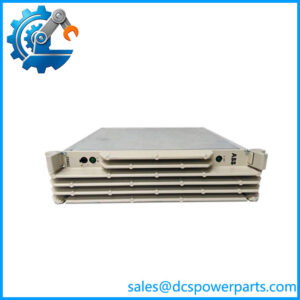
ABB AI880A | S800 I/O 8-Channel High Integrity HART Analog Input Module
Product Introduction
In a safety-related ABB control system, an analog input module has to do more than convert a 4–20 mA signal. The ABB AI880A is an S800 I/O High Integrity analog input module designed to acquire eight single-ended current signals while providing HART pass-through communication, transmitter-power supervision, channel diagnostics, and support for single or redundant configurations. ABB specifies the module for 0–20 mA and 4–20 mA inputs with 12-bit resolution.
The AI880A 3BSE039293R1 is intended for ABB High Integrity architectures, including supported AC 800M/S880 configurations. Each channel can distribute current-limited transmitter power, which is useful with 2-wire and 3-wire field transmitters. Procurement should not treat it as a generic S800 analog input card, though: the exact PM controller, MTU, redundancy arrangement, safety configuration, and approved Safety Manual configuration need to match the installed system.
Key Technical Specifications
| Parameter | AI880A Specification |
|---|---|
| Product Model | AI880A |
| Article Number | 3BSE039293R1 |
| Manufacturer | ABB |
| Product Family | S800 I/O |
| Product Type | High Integrity Analog Input |
| Number of Channels | 8 |
| Input Signal | 0–20 mA, 4–20 mA |
| Signal Type | Unipolar, single-ended |
| HART Communication | Yes |
| Resolution | 12 bit |
| Input Impedance | 250 Ω with TY801 shunt stick at current input |
| Maximum Error | 0.1% |
| Temperature Drift | 50 ppm/°C maximum |
| Hardware Input Filter | 190 ms, 0–90% rise time |
| Update Cycle | 10 ms |
| Maximum Field Cable Length | 600 m |
| Maximum Non-Destructive Input Voltage | 11 VDC |
| NMRR, 50/60 Hz | >40 dB |
| Isolation | Eight channels groupwise isolated from ground |
| Rated Insulation Voltage | 50 V |
| Dielectric Test Voltage | 500 VAC |
| Power Dissipation | 2.4 W |
| +5 V ModuleBus Consumption | 45 mA |
| +24 V ModuleBus Consumption | Maximum 50 mA |
| External +24 V Consumption | 4 mA + transmitter current, maximum 260 mA |
| Transmitter Supply | Current-limited per channel |
| Diagnostics | Fault, Run, Warning LEDs; module/channel supervision |
| Redundancy | Supported |
| High Integrity | Supported |
| Safety Certification | SIL3 according to IEC 61508 |
| Intrinsic Safety | No |
| Compatible MTUs | TU834, TU844, TU845, TU854 |
These values are from ABB’s current AI880A data sheet and S800 Hardware Selector.
Major Features / Advantages
1. Eight high-integrity analog input channels
provides eight 0–20 mA / 4–20 mA current-input channels in a single S800 I/O module. The inputs are single-ended and unipolar, making the module appropriate for conventional process transmitters and other current-loop devices.
The 12-bit conversion resolution is adequate for the module’s intended process-I/O role. This should not be confused with newer high-resolution analog modules simply because both use the mechanical platform.
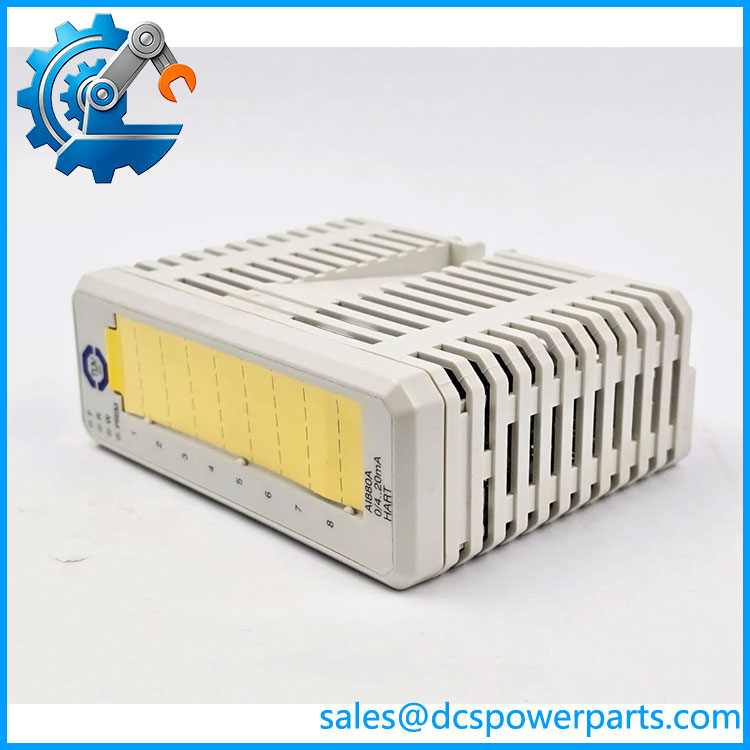
AI880A
2. HART pass-through
A major distinction between and a basic current-input module is HART communication support. The analog process variable remains the primary acquisition signal, while HART provides access to compatible smart-transmitter information through the I/O path.
For maintenance teams, this can reduce the need to treat the 4–20 mA loop and device diagnostics as completely separate systems.
3. Current-limited transmitter power
can distribute external transmitter power to each channel and provides current limiting. ABB specifically describes this function for 2-wire and 3-wire transmitters.
This is useful in cabinet designs where the I/O module needs to provide more than simple signal measurement. The actual field-loop wiring and transmitter power arrangement still need to follow the approved installation design.
4. High-integrity and redundant operation
ABB identifies as a High Integrity I/O module supporting single or redundant configurations and certified for SIL3 according to IEC 61508. The module is intended for safety-related configurations when installed and configured according to ABB’s applicable Safety Manual.
The SIL3 certification belongs to the module and its specified safety architecture; it should not be interpreted as automatically making an entire control or safety loop SIL3.
5. Built-in channel and power supervision
The module monitors internal voltage, field-power input, and field-power output on a channel basis. ABB provides front-panel Fault, Run, and Warning LEDs, with diagnostic indications for module and channel conditions.
This is valuable during commissioning because a transmitter-loop problem can potentially be distinguished from a module-level problem before replacing hardware.
6. NAMUR NE43 support
complies with NAMUR NE43 and supports configurable over- and under-range limits for the current inputs. ABB specifies an over-range capability of +12% for 0–20 mA and +15% for 4–20 mA.
For process engineers, this provides a defined way to distinguish normal process measurement from certain out-of-range or fault conditions.
Application Scenarios & Field Pain Points
- Safety-related process measurement: Suitable for compatible high-integrity architectures where 4–20 mA transmitter signals must be acquired by the safety/control system.
- Smart transmitter integration: HART pass-through makes useful where transmitter configuration and diagnostic information need to remain accessible.
- Redundant I/O: ABB supports in single or redundant configurations.
- AC 800M High Integrity: ABB’s current catalog lists with supported high-integrity AC 800M controllers including PM857, PM863, PM867, PM866A and PM891 configurations.
- S880 High Integrity: is also part of ABB’s High Integrity /S880 I/O offering.
Field note: If one channel suddenly reports an abnormal transmitter value, don’t assume the input electronics have failed. Check loop power, transmitter current, field wiring, HART device status, the channel diagnostic, and the external 24 VDC supply first. The module actively supervises and limits transmitter power, so a field-side fault can present differently from a conventional passive analog input.
Related Products
- AI845 — Standard 8-channel analog input supporting 0–20 mA, 4–20 mA and voltage inputs; unlike , it is not the High Integrity version.
- AI890 — intrinsic-safety analog input module with 0–20 mA inputs; its safety and field-interface architecture is different from .
- AI893 — analog input module for RTD and thermocouple signals; not a current-input substitute.
- DI880 — High Integrity 16-channel digital input module.
- DO880 — High Integrity 16-channel digital output module with 24 VDC, 0.5 A outputs.
- TU834 — Compatible module termination unit for .
- TU844 — Compatible MTU for .
- TU845 — Compatible MTU for .
- TU854 — Compatible MTU for .
- SS823 — High Integrity power voting unit used in the applicable redundant power architecture.
Engineer’s Guide — Field Pitfalls to Avoid
1. Do not confuse with AI845
Both are analog input modules and both can handle 4–20 mA signals, but is the High Integrity version and has a different safety architecture. AI845 should not be treated as a functional safety replacement merely because its basic signal range looks similar.
2. Verify the MTU
ABB specifies TU834, TU844, TU845, and TU854 as matching MTUs for . A replacement card should be checked against the installed termination arrangement before shutdown work begins.
3. Verify the controller and ModuleBus architecture
ABB’s current catalog restricts High Integrity applications to specified AC 800M controllers and ModuleBus arrangements. Optical ModuleBus installations also have specific interface requirements.
4. Do not infer SIL3 from the module alone
is SIL3 certified, but the complete safety function still depends on architecture, configuration, diagnostics, proof testing, application software, field devices, and the applicable ABB Safety Manual. ABB explicitly states that configuration must follow the Safety Manual.
5. Check external transmitter power
can provide current-limited transmitter power, but the external 24 VDC supply and total transmitter demand still need to be checked. ABB specifies maximum external +24 V consumption of 260 mA plus the stated base consumption, so don’t assume unlimited loop-power capacity.
6. Do not treat HART as an independent Ethernet-type interface
HART support here is pass-through communication associated with the analog current loops. is still an analog input module, not a standalone HART multiplexer or general-purpose communications module.
FAQ
What is ABB ?
is an ABB I/O High Integrity analog input module with HART communication. It provides eight 0–20 mA / 4–20 mA single-ended inputs and supports single or redundant configurations. Its article number is 3BSE039293R1.
How many channels does have?
has 8 analog input channels. Each channel accepts 0–20 mA or 4–20 mA signals.
Does support HART?
Yes. ABB explicitly specifies HART pass-through communication for .
Is certified?
Yes. ABB specifies as certified for according to IEC 61508. The module must still be installed and configured according to the applicable ABB Safety Manual and approved safety architecture.
Can be used redundantly?
Yes. ABB identifies for single or redundant configurations. The exact redundancy arrangement and associated controller/ModuleBus architecture must be verified against the project design.
Which termination units are compatible with ?
ABB lists TU834, TU844, TU845, and TU854 as matching module termination units.
What is the difference between and AI890?
is an 8-channel 0/4–20 mA High Integrity analog input module with HART, while AI890 is an intrinsic-safety analog input module for 0–20 mA signals. They serve different field-interface architectures and should not be substituted based only on their similar analog-input function.
What should procurement verify before buying ?
Verify the complete 3BSE039293R1 identification, hardware revision, MTU type, controller/ModuleBus architecture, single versus redundant configuration, HART requirement, safety-system documentation, and actual inventory condition. For a SIL-related application, confirm the proposed replacement against the approved project configuration rather than accepting a generic “ABB analog input” cross-reference.