Description
Key Technical Specifications
| Parameter | Value |
|---|---|
| Product Model | XGM868I-1-21-FI-04164-0 |
| Manufacturer | Panametrics / GE Measurement & Control |
| Product Series | DigitalFlow XGM868i |
| Product Type | Ultrasonic Gas Flow Transmitter |
| Measurement Principle | Transit-time ultrasonic flow measurement |
| Channel Configuration | Single channel |
| Application Medium | Industrial gases |
| Measurement Parameters | Mass flow, standard/actual volumetric flow, velocity, totalized flow |
| Power Supply | 100–240 VAC ±10% standard (configuration dependent) |
| Operating Temperature | Approx. -40°F to 140°F (-40°C to 60°C) |
| Flow Range | Bidirectional measurement capability |
| Accuracy | Typically ±1.5% velocity for two-path systems; configuration dependent |
| Outputs | Analog and digital I/O options available |
| Communication | Serial communication and configurable industrial interfaces depending on option cards |
| Enclosure | Industrial/weather-resistant transmitter housing |
Application Scenarios & Pain Points
A refinery losing confidence in gas flow data does not always have a hardware failure—it may be a calibration drift, transducer issue, or configuration mismatch. Replacement work often fails when teams treat the transmitter as a simple swap instead of a measurement system.
Typical applications:
- Oil & Gas Processing: Used for fuel gas, vent gas, and process gas monitoring where pressure drop from traditional measurement devices is undesirable.
- Chemical Plants: Applied for gas consumption tracking and process balance measurements, especially where corrosive or contaminated streams make mechanical meters difficult to maintain.
- Power Generation: Supports boiler fuel gas monitoring and auxiliary gas measurement loops connected to plant control systems.
- Wastewater and Biogas Systems: Used for digester gas and low-pressure gas flow monitoring where minimal maintenance is required.
Field note: A municipal treatment facility once replaced a failed ultrasonic transmitter during a shutdown window. The hardware swap was straightforward; the difficult part was restoring the original pipe parameters, transducer spacing values, and output scaling. The lesson was simple—meter configuration files are as valuable as the instrument itself.
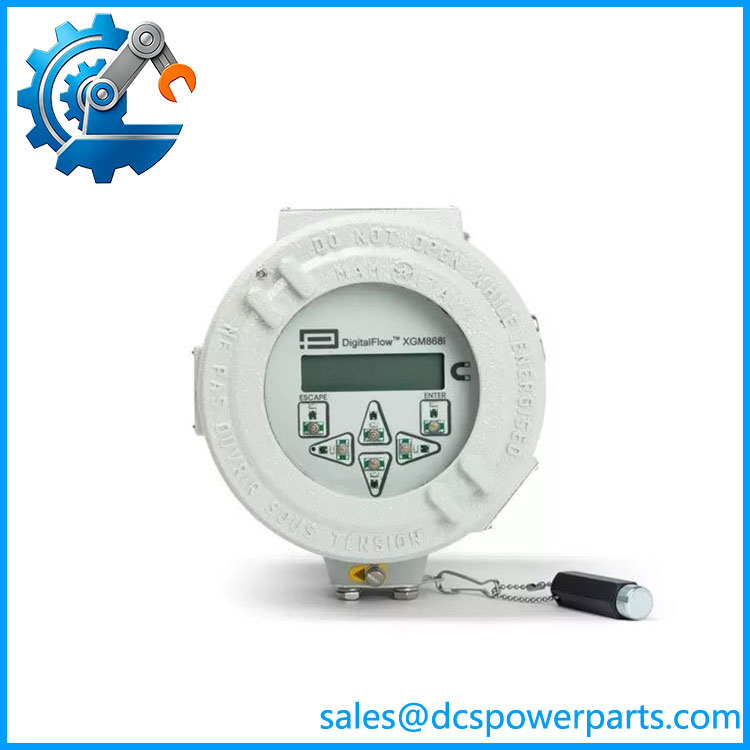
XGM868I-1-21-FI-04164-0
Related Products
- Panametrics XGM868i — Base DigitalFlow gas flow transmitter platform. Suitable when replacing older XGM series equipment while retaining ultrasonic measurement architecture.
- Panametrics GM868 — General-purpose ultrasonic gas flow meter. Used for applications requiring similar measurement principles with different enclosure and installation requirements.
- Panametrics XGF868i — Flare gas measurement transmitter. Designed for flare applications where hazardous-area requirements and unstable gas conditions are major factors.
- Panametrics XGS868i — Steam flow transmitter. Intended for steam measurement rather than general gas service.
- Panametrics XMT868i — Liquid flow transmitter platform. Shares similar electronics concepts but is configured for liquid measurement applications.
- Panametrics PT878 — Portable ultrasonic flow measurement instrument. Used for temporary verification and troubleshooting rather than permanent installation.
- Panametrics PanaView Software Tools — Configuration and diagnostic software used with compatible instruments for setup, logging, and troubleshooting.
The Engineer’s Guide: Field Pitfalls to Avoid
⚠️ Firmware and Configuration Mismatch
A replacement transmitter may power up normally but still produce incorrect readings if software revision, meter configuration files, or site parameters do not match.
How to avoid: Record the original meter setup, including pipe dimensions, gas composition, transducer information, and output scaling before removal.
⚠️ Incorrect Transducer Pairing or Spacing Data
Ultrasonic systems depend heavily on transducer characteristics and installation geometry. A small parameter error can create unstable signal quality.
How to avoid: Verify transducer model numbers, cable lengths, mounting arrangement, and saved calibration data before commissioning.
⚠️ Ignoring Electrical Interface Differences
Older installations may use different communication options, terminal assignments, or output boards.
How to avoid: Confirm option cards, terminal wiring, and loop requirements. A meter body replacement does not guarantee identical I/O configuration.
Frequently Asked Questions (FAQ)
Can I directly replace my existing XGM868i transmitter with XGM868I-1-21-FI-04164-0?
Usually, yes if the original installation uses the same XGM868i configuration. However, the replacement must be checked against transducer type, power supply, I/O options, and stored configuration values. The electronics may fit mechanically while requiring commissioning adjustments.
Does this transmitter require moving parts inside the pipe?
No. The DigitalFlow XGM868i uses ultrasonic transit-time measurement. Since there are no rotating components or internal obstructions, maintenance requirements are different from mechanical flow devices.
What information should I collect before ordering a replacement?
Recommended information:
- Existing model number and serial number
- Transducer model and cable length
- Pipe diameter and material
- Gas composition
- Power supply type
- Existing analog/digital output configuration
Is a refurbished XGM868I-1-21-FI-04164-0 suitable for plant service?
A properly tested refurbished unit can be suitable for industrial service when inspection includes power-up testing, display verification, I/O checks, enclosure inspection, and configuration validation. The key factor is test transparency rather than appearance alone.
Why does the replacement transmitter show a communication timeout?
Common causes include incorrect communication parameters, incompatible interface options, or mismatch between control system settings and transmitter configuration. Verify baud rate, addressing, protocol settings, and installed option boards.
How long does replacement preparation normally take?
Lead time depends on availability, testing requirements, and whether configuration recovery is needed. Units requiring application verification usually need additional engineering review before shipment.
Can the transmitter be used in a DCS migration project?
Yes. The transmitter can support migration projects when engineers verify signal types, communication methods, and scaling requirements. During migration, preserving the original measurement setup is usually more important than replacing the instrument alone.