Description
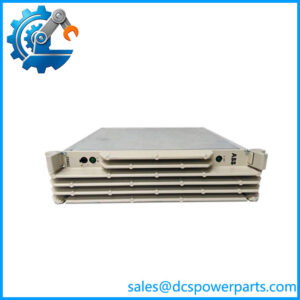
ABB SS823 | 20 A Redundant Power Supply Voter and Overvoltage Protection Unit
Product Introduction
In a high-integrity control cabinet, redundant power supplies are only useful if the downstream system can separate, supervise, and protect those two sources. The ABB SS823 performs that role as a dedicated power-supply voting unit. ABB specifies it for connecting two 24 VDC power supplies to a common protected output while supervising the supplied voltage and generating corresponding status signals. Its rated output current is 20 A.
The SS823 is particularly relevant to ABB AC 800M High Integrity and S880 High Integrity I/O architectures, where ABB specifies a SELV or PELV power supply connected through the SS823. The unit provides double overvoltage protection on both inputs, output overcurrent protection, supervision contacts, and visual LED indication. This is therefore a power-redundancy component—not a replacement for an SD83x power supply itself.
Key Technical Specifications
| Parameter | SS823 Specification |
|---|---|
| Product Model | SS823 |
| Manufacturer / Brand | ABB |
| Article Number | 3BSE038226R1 |
| Product Type | Voter and Over Voltage Protection |
| Primary Application | Redundant DC power supply configuration |
| Input Configuration | 2 × 24 VDC supply inputs |
| Nominal Input Voltage | 24 VDC |
| Rated Output Current | 20 A |
| Maximum Output / Overload Current | 35 A |
| Rated Input Power | 500 W |
| Output Configuration | Dual 24 VDC inputs voted to a single 24 VDC output |
| Load Sharing | Yes |
| Supervision Relay | Yes |
| Output Voltage Regulation | Approximately 1.2 V below input at maximum current |
| Output Overvoltage Protection | <30 V |
| Heat Dissipation | 24 W at 20 A; 6 W at 5 A |
| Maximum Ambient Temperature | 55°C |
| Mounting | DIN rail |
| Width | 116 mm |
| Depth | 145 mm including connector |
| Height | 132 mm |
| Weight | Approximately 870 g |
| Protection Rating | IP20 |
| Corrosive Atmosphere | ISA-S71.04 G3 |
| Hazardous Area | ATEX Zone 2 |
| Marine Certifications | ABS, BV, DNV, LR, CCS |
| Safety Certification | SIL3 according to IEC 61508 |
ABB’s current Hardware Selector identifies 3BSE038226R1 as , with a 20 A rated output, 500 W input rating, 24 VDC nominal input, 35 A overload capability, and DIN-rail installation.
Major Features / Advantages
1. Redundant power-source voting
is designed to accept the outputs of two power supply units and provide a common downstream supply. ABB describes the unit as a control element within a redundant power-supply configuration. The two supply paths are separated and supervised before power reaches the connected consumer.
This is an important distinction for procurement: is the voter, while devices such as ABB’s SD83x products are the actual power supplies.
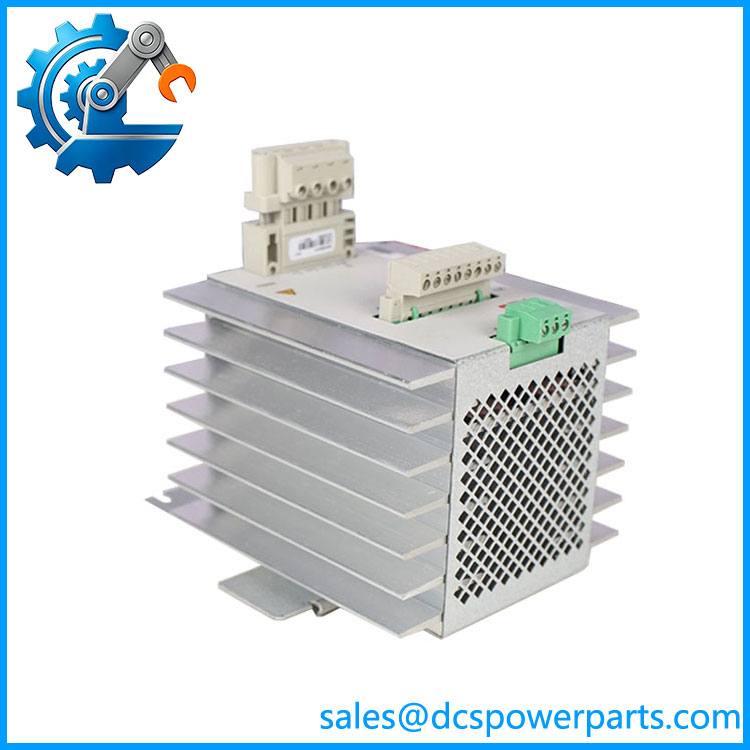
ABB SS823
2. Designed for high-integrity ABB systems
ABB specifically states that the AC 800M High Integrity and connected S880 High Integrity I/O system, including field power, can be supplied from an SELV or PELV power supply through . The System 800xA product catalog also identifies as required in a High Integrity 800xA system.
That makes the unit relevant to safety-system power architectures where simple parallel connection of two DC supplies would not provide the required supervision and isolation behavior.
3. Double input overvoltage protection
The includes double overvoltage protection on its inputs. ABB also specifies output overvoltage protection and current limiting. These functions protect the downstream power bus against certain power-source faults rather than merely selecting whichever input happens to be present.
4. Built-in power supervision
Each power path is monitored. ABB states that green LEDs indicate that the corresponding output voltage is correct, while a voltage-free contact closes the corresponding OK connector path. The voter trip levels are factory preset.
This provides a practical diagnostic point for cabinet alarm systems: a control system can monitor the condition of the redundant power arrangement without relying only on local visual inspection.
5. SIL3-certified architecture component
ABB documents as certified for SIL3 according to IEC 61508. It is also identified as a high-integrity product for AC 800M/S880 applications.
For safety-system procurement, this certification should not be interpreted as making an entire control system SIL3 automatically. The complete safety architecture, configuration, power supplies, wiring, diagnostics, and safety lifecycle requirements still determine the achieved safety integrity.
6. Suitable for demanding cabinet environments
The published specification includes operation up to 55°C, IP20 construction, G3 corrosive-atmosphere classification, and ATEX Zone 2 certification. ABB also lists marine certifications including ABS, BV, DNV, LR, and CCS.
Application Scenarios & Field Pain Points
- AC 800M High Integrity systems: provides the voting function between redundant 24 VDC sources supplying the high-integrity controller/I/O architecture.
- S880 High Integrity I/O: ABB specifies as part of the power arrangement for S880 High Integrity I/O, including field power.
- Redundant control-system power: Two compatible DC power supplies can feed the , with the unit supervising and protecting the resulting power path.
- Industrial and marine control cabinets: Its published environmental and marine certification profile makes it applicable to specified industrial and marine installations.
Field note: If a redundant cabinet reports a power alarm, don’t immediately replace the . Check both upstream power supplies independently, measure both input voltages under load, inspect the DC wiring and terminals, and check which supervision contact has changed state. The voter can only work with the power actually delivered to its two inputs.
Related Products
- ABB SD831 — 3 A, 24 VDC power supply for compatible control/I/O applications.
- ABB SD832 — 5 A, 24 VDC power supply.
- ABB SD833 — 10 A, 24 VDC power supply.
- ABB SD834 — 20 A, 24 VDC power supply; can be used in redundant configurations with appropriate voting units.
- ABB SS832 — Power-supply voting unit for redundant configurations; ABB lists 10 A operation and 20 A in parallel operation.
- ABB PM867K01 — AC 800M High Integrity processor unit used in compatible high-integrity control architectures.
- ABB SM812K01 — Safety CPU module kit associated with PM867 High Integrity configurations.
Engineer’s Guide — Field Pitfalls to Avoid
1. Do not call a 20 A power supply
This is the most important distinction. is a voter and overvoltage-protection unit, while the SD83x family contains the actual 24 VDC power supplies. ABB’s product selector lists separately from SD831–SD854 power-supply units.
2. Do not parallel two supplies directly
The purpose of the is to provide the appropriate voting and supervision function in a redundant power architecture. Directly paralleling two power supplies without checking their intended load-sharing and redundancy architecture can produce a very different electrical arrangement.
3. Verify both upstream supplies
A failed input alarm may actually be caused by an upstream power supply, fuse, connector, or DC wiring problem. Check both sources independently before replacing the voter.
4. Check the safety-system architecture
is documented for SIL3 high-integrity applications, but installing a SIL3-certified component does not by itself establish capability for the complete system. Follow the applicable ABB safety manual and approved architecture.
5. Verify the exact article number
The current ABB Hardware Selector identifies the article as 3BSE038226R1. Older procurement records or field labels may contain additional identifiers. Match the actual nameplate and revision rather than purchasing solely from a generic “ABB ” description.
6. Allow for cabinet heat dissipation
At 20 A, ABB specifies approximately 24 W of heat dissipation. That is significant inside a densely populated control cabinet. Cabinet temperature should therefore be considered when the is operating near its rated load.
FAQ
What is ABB ?
ABB is a redundant power-supply voter and overvoltage-protection unit. It accepts two 24 VDC power-supply inputs and provides a supervised common output for the connected control or I/O load. Its ABB article number is 3BSE038226R1.
Is a power supply?
No. It is a power-supply voting device. ABB’s SD83x family provides the actual 24 VDC power, while combines and supervises two redundant supply sources.
What is the rated current of ?
ABB specifies a 20 A rated output current, with a maximum overload current of 35 A.
What input voltage does use?
The nominal input is 24 VDC, with two supply inputs intended for redundant power-supply configurations. ABB’s System 800xA catalog describes the unit as a dual-24-VDC-to-single-24-VDC, 20 A voting device.
What is the difference between and SS832?
Both are ABB redundant power-supply voting units, but they are different models with different current capabilities and application configurations. ABB currently lists , while SS832 is listed at 10 A, or 20 A in parallel operation. Do not substitute one solely from the word “voter”; check the system load and approved architecture.
Is used with AC 800M High Integrity?
Yes. ABB explicitly identifies for AC 800M High Integrity and S880 High Integrity I/O power arrangements. The System 800xA catalog also identifies it as required in a High Integrity 800xA system.
What should procurement verify before buying ?
Verify article number 3BSE038226R1, the two upstream power-supply models, required output current, high-integrity system architecture, terminal/connectors, certification requirements, physical condition, and test status. If the application is safety-related, verify the complete approved power architecture rather than treating as a standalone SIL component.