Description
ABB RET615 Relion Transformer Protection and Control Relay
Product Overview
The ABB RET615 is a dedicated transformer protection and control relay within ABB’s Relion 615 series. It is designed primarily for two-winding power transformers, including unit transformers, step-up transformers and generator-transformer blocks used in utility and industrial power distribution systems. ABB combines transformer differential protection, measurement, supervision and control functions in a compact withdrawable IED rather than requiring separate devices for each basic protection task.
At the protection level, RET615 is built around transformer-specific fault detection rather than generic feeder protection. ABB documents differential protection with high inrush stability, restricted earth-fault protection, voltage protection and measurement. The available standard configurations are tailored to different transformer neutral-earthing arrangements and CT arrangements. Configurations A, C, E and G are intended for transformers with earthed HV-side neutrals; A/E provide low-impedance REF while C/G provide high-impedance REF. Other configurations address solidly grounded LV sides or LV neutral grounding through a resistor.
Communication is another important part of the RET615 architecture. The relay supports IEC 61850, including GOOSE messaging, while documented product versions also support IEC 60870-5-103, Modbus and DNP3. Later documentation includes IEC 61850 Edition 2 and process-bus functionality using IEC 61850-9-2 LE. This makes RET615 suitable for conventional protection panels as well as digitally integrated substation architectures.
The practical procurement warning is simple: RET615 is not a single fixed hardware configuration. ABB provides multiple standard configurations and allows the application logic to be tailored through PCM600. The exact CT/VT arrangement, binary I/O, communication hardware, protection functions and firmware therefore need to be verified against the complete ordering code and installed relay—not inferred from the family name alone.
Product Introduction
Transformer protection has little tolerance for a “close enough” replacement. CT ratios, transformer vector group, grounding arrangement and differential stabilization all affect whether a relay configuration is actually suitable.
The addresses this through application-specific standard configurations that can be further tailored in PCM600. For a DCS/substation upgrade or legacy relay replacement, preserving the original protection philosophy matters more than simply matching the front-panel dimensions.
Key Technical Specifications
| Parameter | Specification |
|---|---|
| Product Model | |
| Manufacturer | ABB |
| Product Family | Relion 615 |
| Product Type | Transformer protection and control IED |
| Main Application | Two-winding power transformers |
| Other Applications | Unit transformers, step-up transformers, generator-transformer blocks |
| Differential Protection | Transformer differential protection |
| REF Protection | Low- or high-impedance REF depending on configuration |
| Voltage Protection | Available |
| Thermal Protection | Available |
| Overcurrent / Earth Fault | Available within standard application configurations |
| Arc Protection | Optional/configuration dependent |
| Communication | IEC 61850, GOOSE, IEC 60870-5-103, Modbus, DNP3 |
| IEC 61850 | Edition 1/Edition 2 depending product version |
| Process Bus | IEC 61850-9-2 LE on supported configurations |
| Time Synchronization | IEEE 1588 V2 on supported configurations |
| Engineering Software | ABB PCM600 |
| Connectivity Package | Connectivity Package |
| Application Configuration | Signal Matrix / graphical application configuration |
| HMI | Large graphical LCD |
| Mounting | Withdrawable plug-in unit |
| Standard Configurations | Eight configurations documented for IEC |
| CT / VT Inputs | Configuration dependent |
| Binary I/O | Configuration dependent |
| Auxiliary Supply | Ordering-code dependent |
| Firmware | Version dependent |
| Hot-Swap | Do not assume; follow approved protection-relay isolation procedure |
ABB’s product documentation confirms that has eight standard configurations and that the signal configuration can be modified through PCM600.
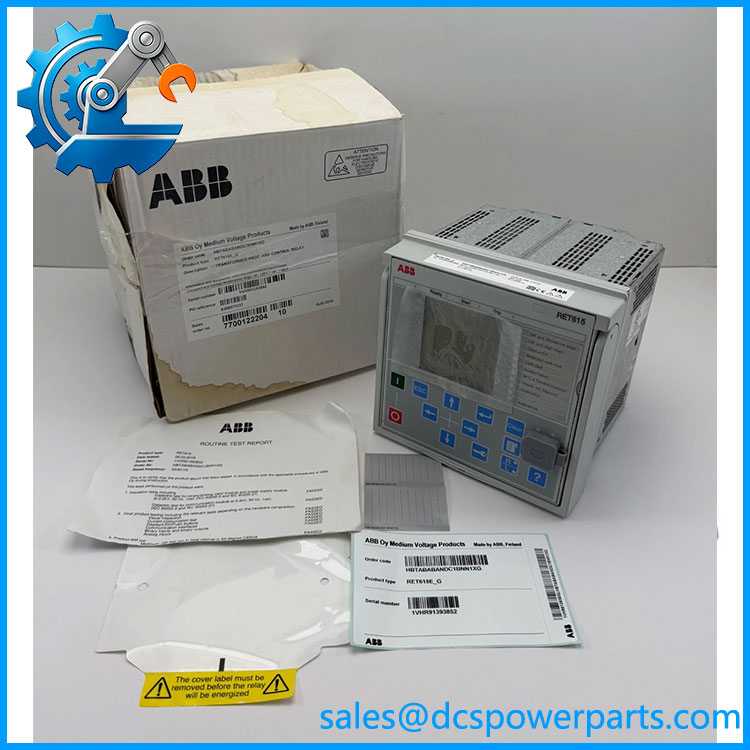
ABB RET615
Major Features / Practical Advantages
Dedicated Transformer Differential Protection
The central function of is transformer protection. ABB specifies sensitive transformer differential protection designed to detect internal faults while maintaining stability during transformer energization. High inrush stability is particularly important because transformer magnetizing current can otherwise create differential current that resembles an internal fault.
This is where differs materially from a standard feeder relay. The protection algorithm has to account for transformer behavior, not simply compare phase currents.
Multiple REF Protection Arrangements
Restricted earth-fault protection is available in different configurations. ABB’s standard configuration matrix distinguishes low-impedance and high-impedance REF implementations according to transformer grounding and CT arrangement.
For procurement, this is not a minor option. An incorrectly selected REF arrangement can affect the entire protection scheme. The existing transformer drawing, CT ratios, neutral CT arrangement and grounding design should therefore be checked before selecting a replacement configuration.
Eight Standard IEC Configurations
IEC is available in eight standard configurations. ABB uses these configurations to cover different transformer grounding and protection requirements, while allowing the signal configuration to be modified through PCM600.
The result is a practical balance between standardized ordering and application-specific engineering. Engineers do not have to build every transformer protection scheme from an empty configuration, but the factory configuration should never be assumed to match a particular site without checking the project files.
IEC 61850 and GOOSE
supports IEC 61850 communication and GOOSE messaging. This allows protection and control signals to be exchanged between compatible substation IEDs without requiring every interlocking or protection status signal to be wired point-to-point.
In an existing digital substation, however, replacing the relay requires more than copying protection settings. IEC 61850 datasets, GOOSE subscriptions, logical-node mapping, VLAN configuration and station-level engineering records may all need verification.
Process-Bus Capability
Later documentation supports IEC 61850-9-2 LE process-bus functionality. This can reduce copper signal wiring by allowing sampled measurement data to be transmitted digitally where the complete substation architecture supports it.
That capability should not be assumed simply because the relay family is . The exact hardware, firmware and application configuration must support the required process-bus architecture.
Withdrawable Plug-In Design
The 615 series uses a withdrawable relay design intended to simplify installation, testing and maintenance. ABB specifically identifies the withdrawable plug-in construction as a product feature of .
That does not mean the relay can be removed from an energized transformer protection panel without a switching procedure. CT circuits, trip outputs and interlocking circuits require controlled isolation before physical withdrawal.
PCM600 Engineering
is engineered using ABB’s Protection and Control IED Manager, . ABB’s documentation identifies functions including parameter setting, firmware update, disturbance handling, signal monitoring, lifecycle traceability, signal matrix configuration and communication management.
For maintenance teams, the project is therefore a critical asset. Losing the engineering file can make a technically compatible spare considerably harder to commission correctly.
Arc-Flash Protection Option
ABB identifies arc protection as an available feature, with optional high-speed outputs in applicable configurations.
Where the relay participates in a switchgear arc-flash protection scheme, the optical sensor arrangement and high-speed trip path must be documented before replacement. Do not assume that the physical relay contains every optional function.
Related Products
- RET620 — Larger Relion transformer protection platform for more demanding transformer protection and control schemes.
- RET630 — Higher-capability transformer protection and control relay for broader application requirements.
- REF615 — Relion feeder protection and control relay; intended primarily for feeder applications rather than transformer differential protection.
- REM615 — Relion motor protection and control relay for medium-voltage motors.
- RED615 — Relion line differential protection and control relay.
- REG615 — Generator and interconnection protection and control relay.
- REU615 — Voltage protection and control relay.
- REV615 — Capacitor-bank protection and control relay.
- REX615 — Newer modular successor platform covering transformer, feeder, machine, line, busbar and other protection applications.
- — ABB engineering environment used to configure, monitor and maintain Relion protection and control IEDs.
FAQ
What is ABB ?
is a Relion 615-series transformer protection and control IED intended primarily for two-winding power transformers, unit transformers, step-up transformers and generator-transformer blocks.
Is a feeder protection relay?
No. ABB positions specifically as a transformer protection relay. The 615 family also includes REF615 for feeder protection, REM615 for motor protection, RED615 for line differential protection and other application-specific relays.
Does provide transformer differential protection?
Yes. Transformer differential protection is one of its primary functions. ABB also specifies high inrush stability for transformer differential protection.
What are the eight configurations?
The IEC product documentation identifies configurations A through H. Their application differs according to transformer neutral grounding and REF implementation. A/C/E/G are intended for earthed HV-side neutrals, while B/D/F/H cover solidly earthed LV sides or LV neutral grounding through a resistor.
Does support IEC 61850?
Yes. supports IEC 61850 and GOOSE messaging. Later product documentation also identifies IEC 61850 Edition 2 and IEC 61850-9-2 LE process-bus functionality on supported configurations.
Can communicate with Modbus or DNP3 systems?
Yes. ABB documents Modbus and DNP3 support in addition to IEC 61850 and IEC 60870-5-103. The exact communication hardware and protocol configuration must be checked against the particular relay.
Does support firmware v3.1?
Do not assume it does. has multiple product and firmware generations, and ABB publishes separate connectivity packages and documentation versions. The installed firmware should be read from the relay or verified through the corresponding project.
Can I hot-swap ?
The relay has a withdrawable plug-in design, but do not interpret that as unrestricted hot-swapping. Transformer protection involves CT circuits and breaker trip circuits. Follow the approved substation switching, isolation and relay replacement procedure before withdrawing the IED. ABB identifies the withdrawable design primarily as a maintenance and installation feature.
Will any replace another ?
No. The family name alone is insufficient. Check the complete ordering code, standard configuration, CT/VT arrangement, neutral CT configuration, binary I/O, communication hardware, firmware, application logic and project.
What should be backed up before replacing ?
At minimum, preserve the project, protection parameters, application configuration, signal matrix, communication configuration, IEC 61850 station files, GOOSE subscriptions, disturbance records where required, and the complete relay ordering code.
Is still relevant for a legacy transformer installation?
Yes, but procurement should account for the specific product and firmware generation. ABB’s current portfolio also identifies REX615 as the next step for the 615/620 series. That does not mean a REX615 should automatically be substituted for an existing ; the protection application and complete system architecture need to be compared.
Procurement Note
For an replacement, the most important information is not simply the relay family name. Record the complete ordering code and confirm:
- IEC or ANSI variant.
- Standard configuration A–H, where applicable.
- Transformer vector group.
- HV and LV CT ratios.
- Neutral CT arrangement.
- Low- or high-impedance REF philosophy.
- Auxiliary supply.
- Binary input/output allocation.
- Arc-flash hardware, if installed.
- IEC 61850 Edition and communication configuration.
- GOOSE datasets and subscriptions.
- Process-bus requirements, if applicable.
- Firmware version.
- and Connectivity Package versions.
- Existing protection settings and customized logic.
ABB explicitly states that the standard signal configuration can be modified through and that application configuration can create additional multi-layer logic using timers, flip-flops and other logical elements.
That is the part worth emphasizing for procurement: a physically matching is not necessarily a functionally matching . For a transformer protection replacement, recover the original configuration before removing the existing relay, then validate differential, REF, overcurrent, trip, alarm, interlocking, communication and disturbance-recording functions after commissioning.